Pentagon chief Pete Hegseth stated during a press briefing on October 20, 2026, that United States policy regarding Ukraine has not changed and Washington has not issued any orders to restrict the operation of Starlink satellite communications on Ukrainian territory. When asked by a journalist whether these words apply to Starshield — the military version of the satellite service — and whether any technical restrictions had been introduced, Hegseth replied categorically: "We haven't restricted anything." According to him, there are terms of service that must be followed, and in this case, Starlink may make its own decisions independently. "But from our perspective, nothing has changed. We haven't issued any orders or anything of the sort. And we, of course, wish the Ukrainians success," the US military department head emphasized.
Context: Starlink speed restrictions in Ukraine
Hegseth's statement came against the backdrop of reports in Ukrainian and international media that Ukraine has faced restrictions on Starlink satellite internet speeds in recent weeks. According to journalistic investigations, these restrictions affect both the system for intercepting enemy unmanned aerial vehicles and the launch of their own drones, creating serious operational problems for the Armed Forces of Ukraine. Notably, on the same day, October 20, Ukrainian President Volodymyr Zelenskyy reported that he discussed intelligence data on Russian ballistics, supplies of interceptor missiles, and the restoration of Starlink with US Secretary of State Marco Rubio. According to Zelenskyy, the parties agreed to maintain contact in these areas. The wording "restoration of Starlink" indirectly confirms that the Ukrainian side is recording changes in the service's operation, although the Pentagon does not directly acknowledge these changes.
Patriot interceptor missiles: US Army priority
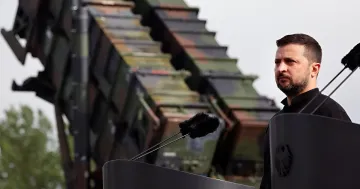
Separately, Hegseth commented on the issue of supplying Patriot interceptor missiles to Ukraine. According to him, the United States primarily wants to ensure that these missiles are available in sufficient quantities to the US Army. "Certainly, in matters concerning assets such as interceptor missiles, we want to make sure that our service members also have the maximum possible number of them. And President Zelenskyy knows this," the Pentagon chief summarized. This position coincides with information published in the media the day before: according to Ukrainian and western publications, the Trump administration is delaying the supply of Patriot interceptor missiles to Ukraine, and Hegseth reportedly has not approved the transfer of these missiles, but has not formally rejected it either.
Diplomatic track: Zelenskyy and Rubio
Against the background of these statements, a telephone contact took place between Volodymyr Zelenskyy and Marco Rubio on October 20. According to information voiced by the President of Ukraine, three key issues were discussed during the conversation: intelligence data on Russian ballistics, the situation with interceptor missiles, and the restoration of Starlink operability. The parties agreed to continue contact in all three areas. Thus, while the Pentagon publicly denies introducing restrictions, at the level of bilateral negotiations, the topic of restoring the satellite service figures as relevant and requiring a solution.
Assessment of the situation
Hegseth's statements lead to the conclusion that Washington maintains its course of supporting Ukraine at the public level, but at a practical level, priorities in the distribution of limited resources — primarily interceptor missiles and, according to indirect data, satellite communication bandwidth — are shifting towards meeting the needs of the US armed forces. The wording "we haven't restricted anything" does not exclude that restrictions could have been introduced at the level of the commercial operator Starlink within the framework of the "terms of service" mentioned by Hegseth, without a direct order from the Pentagon. It is this zone of responsibility — between the military department and the private satellite operator — that remains the most opaque and raises the most questions for the Ukrainian side.