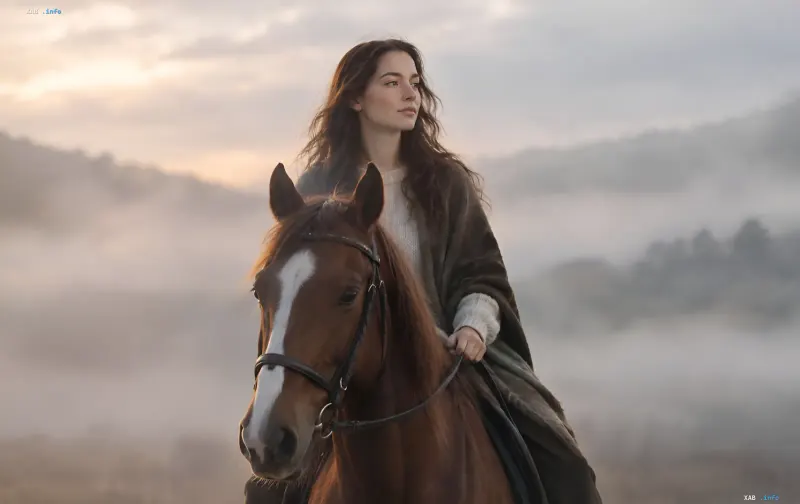
A horse in a dream is one of those images that evokes contradictory emotions in the dreamer: from excitement and a sense of freedom to anxiety and fear. Depending on the animal's behavior, its color, and the circumstances of the dream, the interpretation can change dramatically. Ancient treatises and modern dream books connect this horse with well-being, personal relationships, power, and life circumstances. We examine what ancient thinkers, American interpreter Gustavus Miller, and Sigmund Freud actually invested in the image of the horse.
Ancient Roots: Artemidorus of Daldis and His "Oneirocritica"
The ancient Greek author Artemidorus of Daldis, who lived in the 2nd century AD, devoted five books to the interpretation of dreams, which went down in history under the title "Oneirocritica". In this work, the horse did not have a single fixed meaning: it could personify a wife, a beloved woman, a master, an employer, a friend, or even a ship. The key criterion for Artemidorus was the animal's behavior toward the dreamer. How the horse carried a person was supposed to indicate how close ones, a master, or a friend would treat them in real life.
The American Approach: Gustavus Miller and the Significance of Color
American author Gustavus Hindman Miller in his book "Ten Thousand Dreams Interpreted", published in 1901, paid special attention to the colors and behavior of the animal. Unlike Artemidorus, for whom the context of interaction between the dreamer and the horse was central, Miller focused on external characteristics: the color of the coat, the condition of the animal, and its reaction to the rider. This allowed him to build a more detailed system of interpretations in which, for example, a white horse and a black horse carry fundamentally different messages. Miller's approach became one of the most cited in popular dream books of the 20th and 21st centuries.
Freud: The Horse as a Personal Symbol
Sigmund Freud did not create a universal dictionary in which every animal had a single immutable meaning. In his work "The Interpretation of Dreams", he showed how images in a dream can be connected with personal memories, experiences, and associations of a specific person. As a clear example, Freud described his own dream in which he was riding a gray horse. During the analysis, he associated the color of the animal with the clothing of his colleague, and the image of the horse itself with the history of relations with a patient. Thus, the horse became a personal symbol tied to specific events from the author's life. That is why Freud advised considering not only the plot of the dream, but also what stands behind it in the real life of the dreamer.
Riding: Trust, Control, and Independence
A separate significance in dream symbolism belongs to the plot in which a person does not just see a horse, but mounts it. In such a situation, the horse can symbolically remind one of relationships, trust, and personal independence. In Artemidorus's interpretation, this animal could personify a wife or beloved woman, as well as a master, employer, or friend. A dream about riding can be associated with work, responsibility, friendship, and the desire to control one's life. At the same time, the horse's behavior during a gallop or a calm walk remains an important indicator: an obedient animal points to harmonious relations, while a violent one points to a possible conflict or loss of control.
Why the Same Dream Is Interpreted Differently
Modern interpreters agree on one thing: the horse most often brings good news to a dream — strength, movement, freedom. However, divergences begin in details: in color, behavior, the number of animals, and the actions of the dreamer. Artemidorus saw a reflection of social ties in the horse, Miller saw a set of symbols tied to appearance, and Freud saw a projection of the personal unconscious. That is why there is no universal answer to the question "what does it mean when you dream of a horse": the meaning is determined by the combination of circumstances of a specific dream and the life context of the person seeing it.