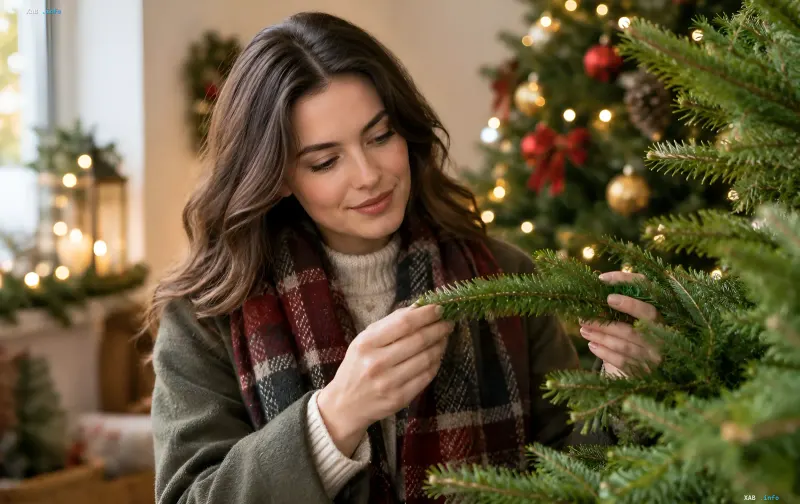
A good Christmas tree at the store doesn't always stay that way at home. Some trees quickly lose their needles, others have an overly strong odor, and some cannot even support the weight of ordinary decorations. To avoid disappointment and prevent your holiday decor from turning into daily cleanup, you should evaluate both real and artificial trees based on a range of practical criteria—from needle material to cut freshness. Here is what to look out for before bringing a tree home.
Artificial Trees: PVC vs. Molded Polyethylene
It would seem simple: a real tree loses its needles, while an artificial one should stand for years without trouble. In reality, plastic trees can also shed, sometimes even during initial setup. The key factor is the needle material. The most common options are polyvinyl chloride (PVC) and polyethylene (PE). Both are types of plastic, but the artificial needles are produced differently. As experts from the center for disease control and prevention explain in an article on the Kosiv City Council website, budget trees are often made from PVC film—plastic cut into thin strips to imitate needles. In molded trees, each branch is formed individually in a special mold. This makes them look much more realistic, and their foliage is usually denser and holds its shape better. There are also combined models: the outer branches are molded, while PVC is used closer to the trunk.
Practical Check: Shake the Branch
An important nuance: molded needles do not guarantee that a tree will never shed. They primarily differ in manufacturing method and realism. The durability of the tree also depends on the quality of the plastic, mountings, and overall construction. Therefore, the best test is practical. Run your hand along several branches and shake them slightly. If a noticeable amount of plastic needles appears on the floor afterward, it is better to look for another model. This simple test takes less than a minute but helps avoid the main problem—daily sweeping under the tree throughout the holidays.
Real Trees: Choosing the Species and Checking Freshness
Choosing a real tree starts with the species. A traditional spruce has a beautiful shape and dense needles, but in a warm room, it loses them quite quickly. According to the UK Royal Horticultural Society, the Nordmann fir retains its needles significantly better. Pine is also a good option. However, even a Nordmann fir will start to shed if it was cut a long time ago or stored improperly. Checking freshness is simple: gently run your hand along a branch. Green needles should hold on well. A few old needles from the interior of the canopy are not a problem, but heavy shedding of fresh needles is a warning sign. Also try to bend a small branch slightly: a fresh tree branch should be flexible rather than breaking at a gentle touch.
Smell and Safety: What Science Says
For some, the smell of pine needles is an inseparable part of the New Year atmosphere; others want a tree that looks beautiful but has almost no scent. With plastic trees, the situation is more complex: instead of a forest aroma, you might get an intrusive new-product smell. According to the US Environmental Protection Agency (EPA), some household materials can emit volatile organic compounds (VOCs)—substances that enter the atmosphere as gases. Some of these can cause eye, nose, and throat irritation. However, the smell alone does not determine how safe the product is: you shouldn't assume any plastic tree with a chemical smell is toxic, nor should you blindly trust an odorless product. Before buying, ask to see the unpacked model, smell the branches, check the packaging details, and look at the manufacturer information. If the smell is sharp, unpleasant, or causes discomfort, it is better to refuse the purchase—do not expect it to necessarily disappear after a few days of airing out.
The Aroma of Real Conifers: From Almost Unnoticeable to Expressive
Not all conifer trees smell the same, and an intense aroma does not necessarily mean the tree is fresh. According to the American industry organization Real Christmas Tree Board, the Nordmann fir has almost no scent, making it a good choice for people sensitive to strong aromas. A regular spruce, by contrast, is known for its distinct coniferous scent—if you are buying a real tree specifically for this, it can be an advantage. A musty smell, however, is a completely different story: if the tree smells damp, mold is visible on the branches, or the needles have unusual spots, it is better not to buy it. Such an odor indicates improper storage and possible fungal growth, which in a closed room can aggravate allergic reactions.
Branch Strength Under Load
A tree can look incredibly fluffy while standing empty. But as soon as you hang a few glass balls, a garland, or heavy figurines, the branches begin to sag. When choosing a tree, especially an artificial one, evaluate the distance between branches and their thickness: overly sparse and thin needles will not support dense decor. For a real tree, this parameter depends on the species and age of the tree—more mature specimens with thick trunks and powerful side branches handle loads better. If you plan to decorate the tree with heavy glass or ceramic toys, choose a model with a dense canopy and test the elasticity of the branches by pressing on them slightly with your finger.