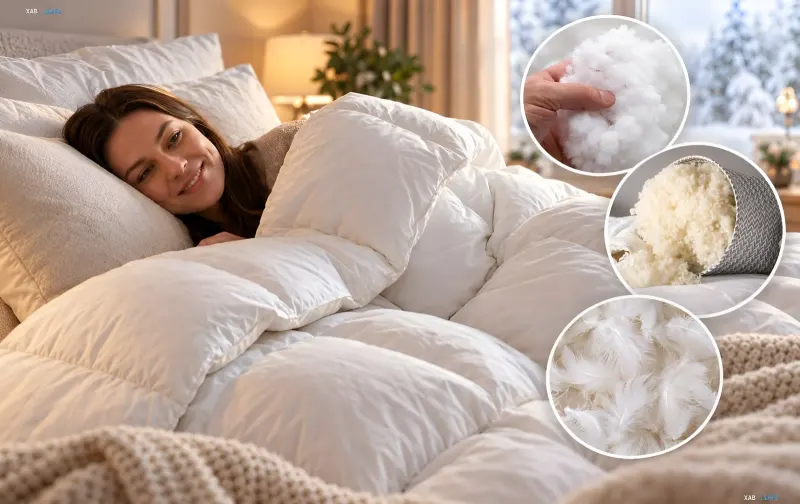
With the first steady cold snaps, choosing a winter duvet becomes relevant for millions of people. The summer model that seemed ideal just yesterday can no longer cope with heat retention, while the night body temperature hitting its minimum around 4–5 AM makes sleep shallow and restless. At the same time, the market offers a huge variety of fillings — from natural goose down to modern hollow polyester fibers — and a thicker or more expensive duvet does not always mean a more comfortable sleep. Let's figure out which characteristics really matter and how the main types of fillings differ.
Why Filling Determines Everything: The Physics of Heat Under a Duvet
A duvet's warmth is determined not so much by its thickness as by the filling's ability to trap air. Air pockets inside the material create a barrier that slows down heat loss from the body. According to Sleep Foundation data, down duvets provide a high level of thermal insulation at a relatively low weight, while synthetic fillings sometimes require a larger volume of material to achieve a similar effect. Wool, in turn, has an additional property: it regulates moisture by absorbing and releasing water vapor. There is no universal filling suitable for everyone without exception: the choice depends on the bedroom's temperature, individual cold sensitivity, and weight preferences.
Down: Lightness and the Fill Power Indicator
Natural down — duck or goose — remains one of the most effective fillings for winter duvets. Its key advantage is a voluminous structure with many air chambers that allows the duvet to keep you warm while remaining lightweight. When choosing a down product, experts recommend paying attention to the fill power indicator, which characterizes the volume occupied by a certain mass of down. Down with a fill power of 700 at the same weight will be noticeably more voluminous than down with a fill power of 500. However, a higher rating does not automatically mean a warmer duvet: the total amount of filling inside the shell is critically important. Among the disadvantages of down models are a higher price and the need for thorough drying after washing, otherwise the fibers lose shape and may clump.
Wool: Natural Thermoregulation and Weight
Wool duvets work on a different principle. Unlike down, which is valued primarily for lightness and thermal insulation, wool fibers actively absorb and release water vapor, helping maintain a comfortable microclimate under the duvet. Sleep Foundation notes that wool provides natural thermal insulation and helps maintain stable sleep conditions. At the same time, wool models tend to be heavier than down ones. For some buyers, this is a significant drawback; for others, it is a pleasant feeling of a dense, 'hugging' cover. An important nuance: not all wool duvets are machine washable, so you must carefully examine the manufacturer's care instructions before purchasing.
Synthetics: From Classic Polyester Padding to Modern Alternatives
Polyester padding (sintepon) was long the most common synthetic filling due to its availability and ease of care. However, it should not be equated with the entire class of synthetic materials: today, manufacturers actively use microfiber, hollow polyester fibers, holofiber, and other structures capable of imitating the softness and volume of natural down. According to Sleep Foundation information, the thermal insulation properties of synthetic fillings directly depend on fiber structure and quantity, so a quality synthetic duvet can easily provide comfort even in severe frosts. The main risk of cheap models is the filling clumping over time, causing the duvet to lose uniformity and cold zones to form in the corners. Modern alternatives to classic synthetic padding largely lack this disadvantage due to improved fiber geometry and stabilizing stitching.
Thickness Is Not the Only Criterion: What to Look for When Buying
Buyers often focus on the visual thickness of a duvet, but this indicator does not always correctly reflect its thermal insulation properties. A thin down duvet with high fill power can warm better than a thick model with a less efficient filling. The product's construction is equally important: shell quality, filling distribution uniformity, and stitched sections that hold the material in place and prevent migration. Sleep Foundation emphasizes that uneven filling distribution creates areas with impaired thermal insulation, directly affecting sleep quality. The optimal strategy is to compare filling characteristics, model seasonality, and personal preferences regarding weight and tactile sensations, rather than relying solely on thickness or price.