The winter season is not without accessories soaked by rain or snow: hats, gloves, and scarves. However, improper drying is one of the main reasons why even high-quality knitwear and leather goods lose their shape, shrink, or become stiff. A wool hat might shrink, an acrylic one might deform, and leather gloves might lose their softness. There is no universal drying method for all materials: the approach depends on fiber composition, knit density, and product construction. We explain how to handle each specific case, based on recommendations from specialized organizations and brands.
First Step — Label and Material Identification
Before proceeding with drying, it is necessary to carefully examine the product's label. Even hats or gloves that look identical may differ significantly in composition: one may be dominated by wool, another by acrylic, and a third by cotton or polyester. The Woolmark organization, in its wool care recommendations, emphasizes that items made from this material should be dried strictly according to the label instructions, avoiding excessive stretching. For wool knitwear, it is critical to maintain the original shape while drying: that is why a wet item should not be hung on hangers or suspended by the edge — it will stretch under its own weight, especially if these are dense and bulky knitted items.
Wool and Acrylic: Horizontal Drying on a Towel
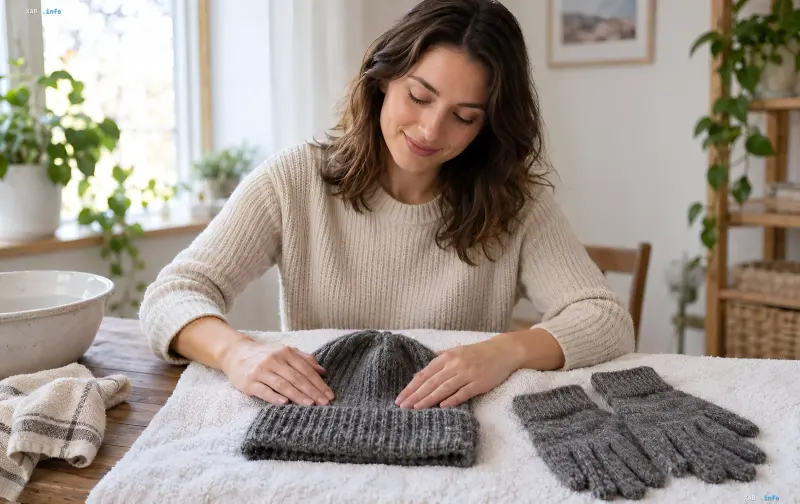
Wool and acrylic hats and gloves are best dried horizontally. The practical algorithm is as follows: place the item on a light-colored terry towel, carefully smooth it out with your hands, restore its original shape without stretching the edge or applying force. Woolmark explicitly recommends drying knitwear on a flat surface, avoiding hanging. Acrylic items usually dry faster than wool, however, this does not mean they can be placed on a radiator or near other heat sources. High temperatures deform synthetic fibers, and the hat or gloves will permanently lose their shape. After removing excess moisture, lay the item on a towel, smooth out the seams and cuff; if there is a pom-pom on the hat, make sure it is not pressed down and has not lost its volume.
Cotton and Fleece: Attention to Hidden Moisture
Cotton has high hygroscopicity: such items can remain wet inside for a long time, even when the outer surface seems dry. After blotting with a towel, lay the cotton hat on a horizontal surface and periodically check its inside. Hanging wet cotton knitwear by the edge is not recommended — it will stretch under the weight of the water. Fleece, made mainly from polyester, does not require complex care and dries relatively quickly. It is sufficient to blot the item with a towel and leave it in a well-ventilated room. It is strictly recommended not to use an iron or hot hair dryer air: the synthetic fibers of fleece are sensitive to high temperatures and may melt or deform.
Gloves with Lining and Membrane: A Complex Case
With gloves, the situation is complicated by the presence of an inner layer. If the outer surface is already dry, this does not guarantee that moisture has not remained inside. Blot the gloves with a towel, straighten the fingers and cuffs, and place them on a dry surface. Do not wring out or stretch the fingers while trying to speed up the process. For models with a membrane, such as GORE-TEX, the manufacturer recommends gently squeezing out the water from the fingers to the wrist after washing and drying the gloves in a suspended state with the wrists facing down. When the item is partially dry, you can put it on and clench your hand into a fist to restore the original shape. It is important to follow the instructions for the specific model, as the membrane construction may vary.
Genuine Leather and General Errors
Genuine leather is particularly vulnerable to improper drying. Placing wet leather gloves on a radiator or using a hair dryer leads to material overdrying, loss of softness, and irreversible hardening. The brand Aspinal of London advises drying leather gloves exclusively by natural means, away from direct sunlight and heat sources, periodically checking the shape of the item as it dries. For any accessory that has gotten wet in rain or snow, a simple trick is universal: blot with a towel, smooth out, and leave on a horizontal surface in a ventilated room. Even high-quality hats and gloves can lose their shape due to several failed drying cycles, so observing basic rules — horizontal position, absence of direct heat, checking internal moisture — allows extending the service life of winter accessories for several seasons.