Yellow deposits at the bottom of the toilet eventually turn into a dense scale that can no longer be removed with an ordinary brush or regular cleaning agents. The problem is especially relevant for owners of hard water: mineral substances gradually accumulate on the inner walls of the bowl, layer on top of each other and harden, forming a persistent crust. That is why tackling such contamination requires not a mechanical but a chemical approach — acidic formulations capable of dissolving mineral deposits rather than simply scraping them off.
Why yellow scale appears
The main cause is high water hardness and the long-term accumulation of mineral salts. The harder the water in the supply, the faster the deposits grow. Over time they harden and become resistant to standard household chemicals. A secondary factor is uric calculus, which also settles at the bottom and under the rim. That is why acidic products are suitable for removing old deposits: they soften and dissolve the mineral crust rather than merely masking it.
Home remedies: vinegar, citric acid, and tablets
The most accessible method is table vinegar. It contains acetic acid, which softens limescale and uric calculus. Before application, it is recommended to reduce the amount of water in the bowl so that the product stays in contact with the stain for longer; if the deposits do not go away the first time, the procedure is repeated. An alternative with a less pungent smell is citric acid: the sanitary ware manufacturer Gustavsberg recommends precisely this when ordinary cleaning does not help. Dissolve 2–3 tablespoons of the acid in a liter of water and apply it to the affected areas; the method is especially effective against minor and moderate deposits. A separate life hack is dishwasher tablets: place one or two tablets at the bottom for several hours, then scrub the bowl with a toilet brush and rinse.
Specialized chemicals and manufacturer recommendations
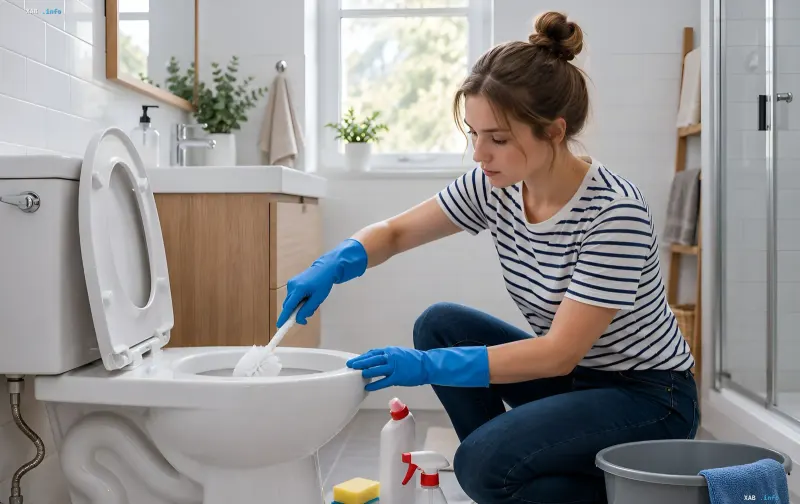
For a thick layer of old scale, home remedies are often insufficient — here you need specialized formulations against limescale. Kärcher specialists emphasize: acidic products do effectively remove mineral deposits, but they should be chosen with the surface material in mind. The key rule is to strictly follow the manufacturer's instructions, not exceed the recommended contact time, and work in protective gloves. Misusing household chemicals can not only damage the sanitary ware but also harm your health.
Safety: what you must not do
It is strictly forbidden to mix vinegar or citric acid with products containing chlorine, as well as to use aggressive acids not intended for cleaning sanitary ware. The U.S. Centers for Disease Control and Prevention (CDC) warn that mixing chlorine bleach with other cleaning agents leads to the release of respiratorily hazardous fumes. This is one of the most common household incidents involving poisoning by toxic vapors, so combining different types of chemicals is unacceptable.
Preventing recurrence
To prevent hard deposits from building up again, the inner surface of the toilet needs to be cleaned regularly, paying special attention to the bottom of the bowl and the areas under the rim. It is important to keep the cistern in working order and avoid constant water leakage, as well as to periodically apply products against limescale. Systematic prevention reduces the need for aggressive "heavy-duty" chemicals and extends the service life of the sanitary ware.