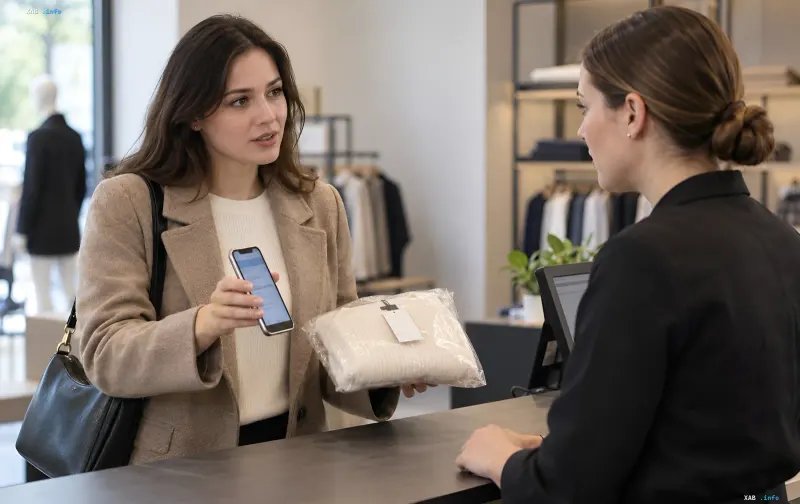
Shoppers who have lost their fiscal receipt often face a categorical refusal from sellers to take items back. However, Ukrainian legislation does not strip citizens of all rights in such situations—nor does it guarantee an unconditional return. The key guideline here is Article 9 of the Law of Ukraine "On Consumer Protection," which explicitly establishes the presence of a payment document as a condition for exchanging non-food products of proper quality. This means that a bank statement or a photo of the item does not automatically replace a receipt, and stores are entitled to refuse in a number of cases. Nevertheless, the State Service of Ukraine on Food Safety and Consumer Protection (Prodspivzhivsluzhba) recommends not giving up after the first refusal, but instead systematically gathering alternative proofs of purchase and contacting the seller with a specific request.
What the Law Says: A Receipt Is Not a Formality, It Is a Condition
To exchange a quality item that simply didn't fit in size, style, or configuration, Article 9 of the Consumer Protection Law sets a requirement for a payment document. The receipt is precisely what records the fact of purchase, the transaction date, and the item's cost. If the document is lost, the seller is not obligated to take the item back by way of exchange, although they aren't forbidden to—and this is a crucial distinction. A store may agree to accept the item voluntarily, but the law imposes no legal obligation to do so without a receipt for a quality item. It is a different matter if the seller failed to issue a receipt at the time of purchase: in this case, the business violates the obligation to provide a payment document, and this fact can be reported to the State Tax Service, while consumer rights violations can be reported to the Consumer Protection Service.
Step-by-Step Algorithm: What to Do If the Receipt Is Lost
The first and simplest step is to try and recover the document. If a phone number or email address was provided at checkout, one should check the inbox and spam folder for an email from the store, look into their personal account on the seller's website, and review order history. When purchasing from a retail chain, it is recommended to contact store staff or support, providing the approximate date and time of purchase, the item's name, cost, and payment method—this data is usually enough to find the transaction in the POS system. Concurrently, one should open their banking app, check payment history, and generate a statement for the relevant period if necessary. This will confirm that a payment to a specific seller took place, even if it doesn't always specify which exact item was bought. If the purchase was made online, keep order confirmations, email correspondence, shipping notifications, and payment service documents; in case of delivery via postal operators, keep shipping and payment details. At the store, explain the situation to the administrator, ask them to check the transaction, and provide a copy or electronic payment document if technically feasible. Important: do not remove tags, do not throw away packaging, and do not use the item if a return is planned—to exchange a quality item, it is critical to preserve its appearance, consumer properties, seals, and tags.
Defective Goods: A Separate Legal Regime
If an item breaks or a manufacturing defect is discovered, the situation is governed not by Article 9, but by Article 8 of the same law. Here, the buyer's demands depend on the nature of the defect, warranty terms, and the circumstances of its occurrence. In cases stipulated by law, the consumer has the right to demand free elimination of defects, a price reduction, or—in the presence of a substantial defect—product replacement or a refund. It is fundamentally important not to confuse a manufacturing defect with damage caused by improper operation: it is precisely the circumstances of the defect's appearance that determine whether the demand for replacement or refund will be met. If the seller refuses to consider the claim, the buyer can contact the Consumer Protection Service, attaching copies of available documents, the written appeal to the store, and the response received (if any).
When a Store's Refusal Is Lawful Versus Unlawful
Refusing to exchange a quality item in the absence of a receipt and the inability to confirm the purchase by other means is generally lawful: the law does not compel sellers to take items back without a payment document. However, refusing to consider a complaint regarding defective goods, including when a warranty card, delivery note, or correspondence with the seller is present, already goes beyond legal grounds. In such a situation, the buyer is protected by the right to appeal to the Consumer Protection Service. The practical conclusion for the buyer: the more complete the package of supporting documents—from bank statements to screenshots of correspondence—the higher the chances of a voluntary settlement of the dispute with the seller without resorting to supervisory authorities.