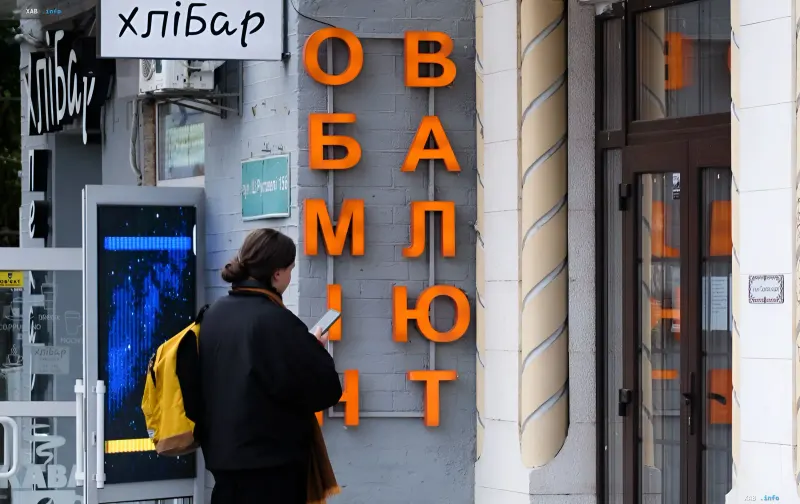
Ukraine's autumn foreign exchange market demonstrates a noticeable acceleration of hryvnia devaluation, which by the end of October 2026 pushed the dollar exchange rate on the interbank market to 45.56–45.70 hryvnias, and on the cash market above 46.00–46.30 hryvnias per dollar. The year began with an official rate of 42.35 hryvnias/dollar, and although the National Bank's flexible exchange rate strategy excluded sharp spikes, the accumulation of negative factors — from budget gaps to a reduction in foreign exchange earnings — led to the interbank market opening at 45.56 hryvnias/dollar on October 29. On Friday, October 30, the regulator adjusted the fluctuations, and the interbank market closed at 45.39 hryvnias/dollar, while the NBU official rate for October 31 and November 1 was set at 45.53 hryvnias/dollar. Notably, these values practically coincide with the rate embedded in the State Budget draft for 2026 (45.7 hryvnias/dollar), emphasizing the scale of the shift that occurred over several months.
Record interventions: NBU sells currency at unprecedented paces
The main tool for market stabilization remains the National Bank, which acts as the primary seller of currency. While in the first half of 2026 average weekly intervention volumes were approximately $900 million, in recent months they have consistently exceeded $1.2 billion per week, totaling over $5 billion per month. According to data available at the end of October, the volume of NBU currency sales between September 28 and October 23 has already exceeded $5 billion, and following September, interventions reached over $5.5 billion compared to $4.8 billion in August. Vice President of the Association of Ukrainian Banks and Chairman of the Management Board of Globus Bank Sergiy Mamedov notes that the burden on the regulator has noticeably increased compared to the first half of the year, and it is international financial assistance along with currency reserves that allow the NBU to prevent an excessive imbalance between supply and demand.
Why currency demand does not fall: infrastructure attacks and import pressure
Demand for currency from importers remains at a very high level against the backdrop of massive attacks on energy and industrial infrastructure. Businesses are forced to buy imported equipment — generators, spare parts, grid restoration elements — which generates stable currency demand. Simultaneously, these same events reduce export capabilities and the country's overall foreign exchange earnings, creating double pressure on the exchange rate. Leading expert of OTP Bank's global markets department Anton Kurynny notes that after breaking the previous maximum of 45.10–45.15 hryvnias/dollar, demand rose sharply up to 45.70, and for two consecutive days record trading volumes for the month, and perhaps for the year, were recorded: trading volume on the Bloomberg platform reached about $400 million per day. At the same time, Kurynny emphasizes that all this happened with the constant support of the National Bank.
Budget effect of devaluation and underfunding risks
In addition to market factors, budget dynamics affect the exchange rate. Skepticism is growing in the market due to the risk of under-receiving about 70 billion hryvnias in tax revenues until the end of the year, as well as a shortage of about 70 billion euros in international financing for next year and a reduction in external inflows in October. On the other hand, a higher dollar exchange rate provides the government with a certain financial effect: each weakening of the hryvnia by 1 hryvnia provides an additional 4–5 billion hryvnias to the state budget due to exchange rate differences when revaluing foreign currency liabilities and revenues. Thus, devaluation within a certain range performs the function of partially covering gaps in the state budget, which objectively reduces incentives for a sharp strengthening of the national currency.
November forecast: 45.00–45.75 corridor and temporary support from tax payments
Experts do not expect a significant strengthening of the hryvnia in November 2026. The consensus forecast assumes the exchange rate moving within the corridor of 45.00–45.75 hryvnias/dollar. Short-term support for the national currency may be provided by the payment of quarterly taxes in November, which traditionally increases the supply of currency on the market. However, analysts do not forecast a sustainable trend reversal without the inflow of new tranches from international partners and the restoration of export earnings. The NBU's flexible exchange rate strategy, as before, excludes a sharp devaluation scenario, but also does not imply active strengthening: the regulator will continue to sell currency in volumes necessary to meet importer demand, relying on reserves and external financial support.