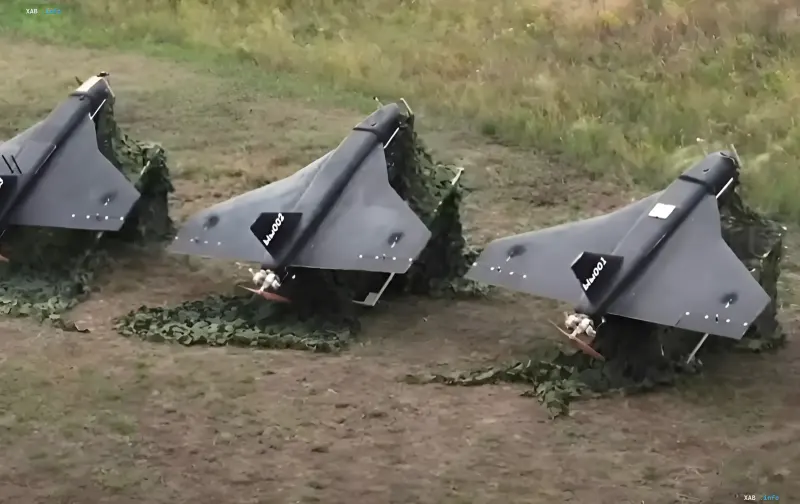
The press service of the Main Directorate of Intelligence of the Ministry of Defense of Ukraine has published a detailed technical analysis of the upgraded Russian 'Gerbera-2' unmanned aerial vehicle, which, according to the agency, is capable of covering distances of up to 1,200 kilometers and carrying an increased combat payload. This is reported by RBC-Ukraine citing HUR materials. The examined sample, judging by the published photos, is a deployed structure with characteristic triangular wings, camouflaged with vegetation in an open area, which indicates the analysis of a captured or downed apparatus.
From Decoy to Long-Range Strike Platform
Initially, the 'Gerbera' family of drones was developed as decoys designed to overload enemy air defense systems. The early modifications — 'Reconnaissance' and 'Kamikaze' — remained relatively simple and inexpensive devices. However, according to HUR's assessment, over time their internal equipment began to approach the level of significantly more expensive UAVs: mesh modems, gimbal-mounted cameras, and other components previously uncharacteristic of cheap decoys appeared on board. It was this evolutionary path that led to the creation of an enlarged version, which Ukrainian intelligence classifies as 'Gerbera-2'.
Dimensions, Fuel System, and Engine
The new sample has a wingspan of three meters and a fuselage length of 2.6 meters. The key change that ensured the increase in range was a 63-liter fuel tank, allowing the device to cover up to 1,200 kilometers. To maintain aerodynamic stability during maneuvers, the internal volume of the tank is divided into separate sections. Propulsion is provided by a two-cylinder two-stroke engine, which, according to intelligence, is actually half of the 'Geran-2' propulsion system, the production of which was localized at a site in Alabuga.
Electronics and Optics: A Chinese-American Mix
The electronic equipment of the 'Gerbera-2' includes an updated flight controller, a 12-channel 'Kometa' system, a mesh modem manufactured by Shenzhen Sinosun Technology Co., Ltd, and a new 'Sosiska' video processing unit implemented on the basis of the Chinese Coke Pi microcomputer. A dual IP camera fixed on the fuselage above the fuel tank and designed to detect interceptors was recorded on the examined sample. HUR also points to the existence of versions with forward-facing IP cameras and cameras on three-axis gimbals. Based on the combination of components, the agency notes, parts from Chinese and American manufacturers predominate in the new 'Gerbera'.
Combat Part and Tactical Capabilities
The examined sample used a 10 kg OFZBCh-10 high-explosive fragmentation incendiary warhead, supplemented by separate bags with an incendiary mixture. The maximum mass of the warhead that the device is capable of carrying is up to 25 kilograms. Thus, the 'Gerbera-2' is transforming from a cheap decoy into a full-fledged strike platform capable of inflicting incendiary and fragmentation damage at a significant distance from the front line.
Context: Effectiveness of Ukrainian Air Defense
The publication of the new drone's characteristics coincides with data that the Ukrainian air defense system is gradually increasing the interception rate of Russian jet-powered attack UAVs. According to previously published information by RBC-Ukraine, the average destruction rate of 'Geran-4' is approaching 60%. Nevertheless, the appearance of devices with increased range and payload indicates that the Russian side is continuing to modernize its UAV fleet in the direction of expanding the destruction radius and increasing the destructive potential of each individual sortie.