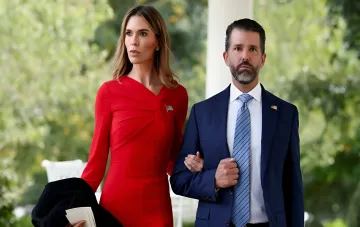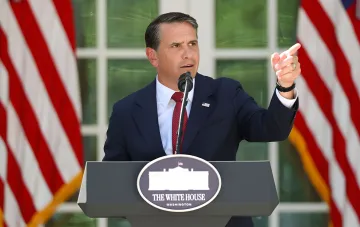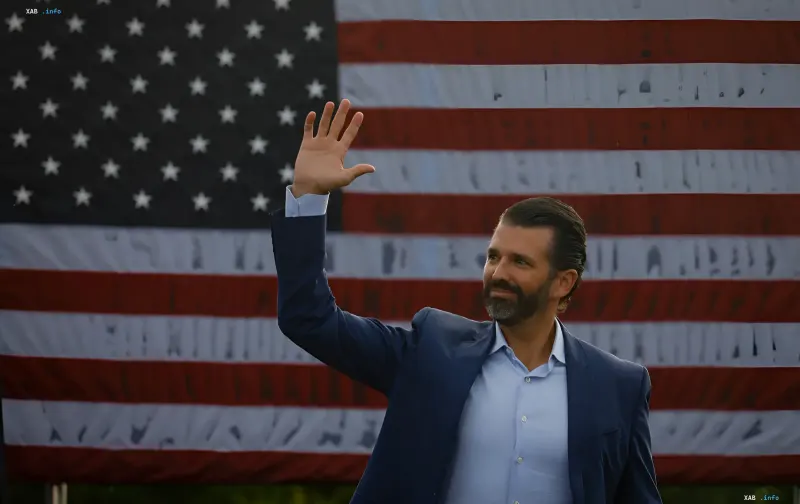
An investigation by the American outlet ProPublica, re-verified by Ukrainian and British media, revealed that Umar Kremlev, head of the International Boxing Association (IBA) — an oligarch close to the Russian leadership — secretly paid hundreds of thousands of dollars in expenses for the three-day wedding of Donald Trump Jr. and Bettina Anderson, held in May on a private island in the Bahamas. According to the journalists and financial documents, Kremlev fully covered the rental of the island for the guests' accommodation, paid for a large-scale celebratory fireworks display, and his team directly participated in planning the event. The payments, according to the investigation's materials, were processed through the Dubai-based entity IB Challenger, which the IBA uses for operations to circumvent international sanctions after relocating its financial activities from Switzerland.
Luxury Described as a "Small Gathering"
The wedding itself was organized by the planners as a closed three-day event: the guests were provided with dancer performances, helicopter flights, a multi-tiered cake, and a massive fireworks display over the water. At the same time, Donald Trump Jr. himself later commented on the event in extremely restrained terms: "It was really a small gathering, like, very close friends. We tried to keep it all together. And it was just wonderful." The contrast between the description of the event in the financial documents and the groom's public rhetoric became one of the key elements of the ProPublica investigation.
Russian-Speaking Guests and the Trail of the Delegation
A group of people speaking Russian were present at the event, although they barely appeared in the official photographs. Among the guests, the journalists identified businessman Alexander Lagutin, who held senior positions in Russia's defense sector and energy industry. Notably, a few days before the wedding, Lagutin and Kremlev were in China as part of a delegation accompanying Vladimir Putin, and about a month earlier the Russian leader had awarded Kremlev the "Order of Friendship." According to ProPublica's assessment, the totality of these details indicates that the wedding was not simply a private event, but a platform for strengthening ties between the Kremlin's inner circle and the Trump family.
Reactions: From "Personal Friend" to "Never Heard the Name"
Donald Trump Jr.'s spokesperson did not deny the fact of the financing and stated that "Umar is a personal friend of Donald's," with whom he had grown close due to their shared passion for boxing and hunting. Kremlev's press office confirmed "friendly relations," assuring that he "never discussed political issues with any of his American friends." However, a representative of the groom's brother, Eric Trump, gave a fundamentally different assessment: "Eric has absolutely no idea who this person is and has never heard his name." The authors of ProPublica specifically note that "it is unclear why Kremlev helped pay for Donald Trump Jr.'s wedding," since, according to their data, the men had met recently, and Trump Jr. could objectively have afforded to pay for the event himself.
Who Is Umar Kremlev: From a Criminal Record to Control Over the Market
According to media reports, Kremlev's real surname is Lutfullov. In 2009 he had a criminal record for extortion and assault. His rapid career rise, according to investigative reports, was thanks to Alexei Rubetsky, head of Vladimir Putin's personal security. Subsequently, Kremlev gained control over the sports betting market in Russia, a nationalized car dealership, and the lottery business. Officially, the IBA was previously funded by Gazprom, and experts still consider its current sources of funds to be linked to the Russian state. In addition, Kremlev participates in the activities of the organization "Healthy Motherland," which Ukrainian and international human rights structures have linked to the abduction and deportation of Ukrainian children from temporarily occupied territories under the guise of "rehabilitation."
Contradictory Data
The investigation's materials and the parties' statements record a number of inconsistencies. First, Trump Jr. characterizes the event as a "small gathering of close friends," while ProPublica's financial documents record the rental of an entire island, helicopter flights, dancers, and fireworks — that is, a format incompatible with a "small" event. Second, positions diverge within the Trump family: Donald Jr.'s spokesperson emphasizes a "personal friendship" with Kremlev, while Eric Trump's representative categorically states that he "never heard" Kremlev's name. Third, Kremlev's press office confirms "friendly relations" but denies discussing political issues, while the very fact of Lagutin's presence at the wedding — a figure from Russia's defense sector — and Kremlev's prior participation in Putin's delegation in China create a context that goes beyond "personal friendship." ProPublica does not publish the full financial statements, so the exact amount of Kremlev's expenses (the sources use the phrase "hundreds of thousands of dollars") has not been confirmed by an independent audit.
Assessment by U.S. Counterintelligence and the Sanctions Context
U.S. experts in the counterintelligence field have expressed serious concern. Former FBI agent Frank Montoya Jr. stated: "If I pay for your wedding, then at some point you will owe me something." Former counterintelligence director at the U.S. National Security Council Golden Triplett added that Russian intelligence services systematically seek access to American officials and their families, and that "money is a proven method of gaining access." Against the backdrop of these statements, on the same day in Brussels, EU countries were unable to agree on extending anti-Russian sanctions: lobbying efforts by two Russian oligarchs — Alisher Usmanov and Mikhail Fridman — prevented a unanimous decision, which, according to observers, reinforces the overall picture of attempts by Russian capital to influence Western politics through personal connections and financial incentives.