
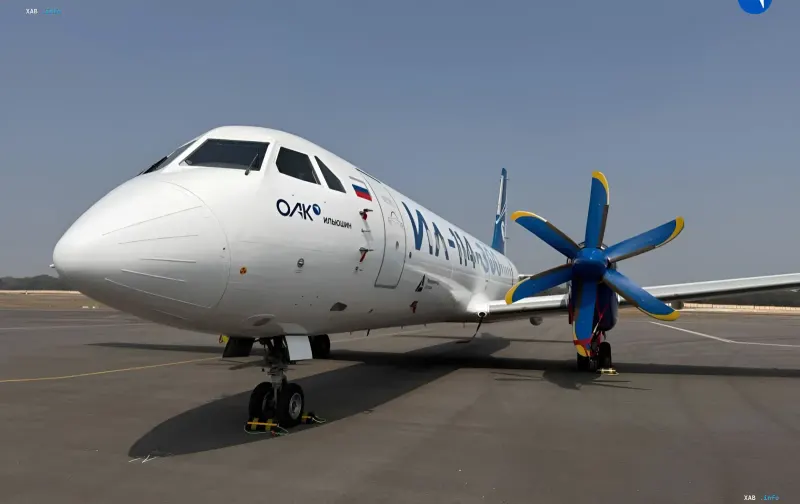
The turboprop Il-114-300 aircraft, which Russia positions as a key tool for import substitution on regional routes, has turned out to be limited in its operational capabilities. Despite loud claims about replacing foreign machines and servicing the Arctic zone, the aircraft, which is guarded like the apple of one's eye, has serious limitations regarding climatic conditions.
Certificate limiting flights
According to data obtained by RBK-Ukraine citing The Moscow Times, the basic certificate issued by Rosaviatsia in early June imposes strict prohibitions on the operation of the Il-114-300. The aircraft, which was supposed to become a savior for northern regions, is not allowed to fly outside the temperature corridor of -9 to +25 degrees.
This casts doubt on its effectiveness for working in the harsh conditions of the Arctic, where it was originally planned for deployment. The document also limits the geography of flights: the aircraft can be operated approximately up to the 70th parallel, which does not allow it to go far into the island Arctic zone. In addition, the maximum flight altitude is limited to 7,600 meters.
Problems with import substitution and deadlines
The Il-114-300 is a modernized version of the basic Il-114-100 model. It was previously stated that the updated model would be able to perform flights in severe frosts in regions such as the Arkhangelsk region and Yakutia. However, reality turned out to be harsher than expectations.
The schedule for certification and launch of the project has been constantly postponed. Initially, the aircraft was planned to be certified in 2023, then the deadlines were moved to 2025, and now to 2026. In early June, the head of the Ministry of Transport, Andrey Nikitin, stated that the delivery of the first three aircraft is expected as early as this year, and another three will be released in 2027.
Rising prices and alternatives
During the development and postponement of deadlines, the cost of the project increased significantly. The price of the aircraft rose from 1.44 billion rubles to 2.6 billion. Against the backdrop of these problems, Russia is forced to look for other ways to solve the transport problem in the regions.
Due to sanctions and the failure of import substitution projects, the Russian Federation decided to revive old An-2 aircraft. The Siberian Scientific Research Institute of Aviation proposed to lift about 700 such machines from storage bases. This decision looks like a forced step back in technology, considering that in July 2024, a passenger "import-substituted" Superjet 100 aircraft crashed in the Kolomna district of the Moscow region, with three people on board.


