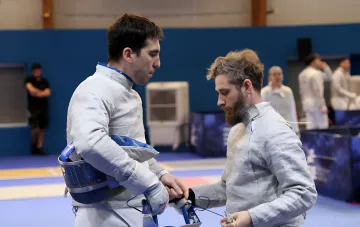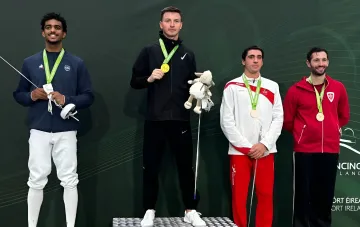
Mikhail Ilyashev, President of the National Fencing Federation of Ukraine, outlined in an exclusive interview with Sport RBC.UA the key problems facing Ukrainian fencing amid the full-scale war. In his words, the central challenge is not so much sporting competition as the demographic and socio-political crisis that directly threatens the very existence of the sport in the long term.
The demographic challenge: war, emigration and falling birth rates
Ilyashev directly linked the main problem in fencing to the war's impact on the country's population. “If we are talking about the biggest problem, it is the war and the disappearance of a large number of people. Some are killed, some leave Ukraine, and we are losing our young people. Birth rates are falling, and our main challenge is to keep the number of children practicing fencing at least at pre-war levels,” the federation president emphasized. In other words, this is not about isolated losses but about a systematic shrinkage of the talent pool that could affect all age groups — from juniors to senior athletes.
Positive dynamics in children's fencing
Despite the grim demographic picture, Ilyashev noted that the federation has so far managed to hold and even grow its numbers in the younger age categories. “For now, we are managing to cope with this task. Last season, the number of participants in our children's league actually increased by 15%,” he said. This growth, against the backdrop of an overall population decline and the outflow of young people abroad, is assessed by the federation president as evidence that, given the right infrastructure and coaching support, children's interest in fencing is being preserved. Nevertheless, Ilyashev stressed that a 15 percent increase is not yet a guarantee of long-term sustainability, and without systematic support the trend may not hold.
Coaching potential as a strategic resource
A separate part of the conversation was devoted to staffing coaching positions. Ilyashev drew attention to the need to build a “conveyor” in which athletes who have ended their careers move into coaching. By his logic, it is precisely former athletes who have made their way from a children's section to international competition that can ensure the continuity of methods and maintain a high level of training. In a situation where some coaches are also leaving the country or changing their line of work, the question of retaining coaching talent within fencing takes on the character of a strategic task.
Financial shortfall and the World Championship in Hong Kong
The federation president did not hide the acute shortage of funds needed for the national team's full participation in international competitions. As an example, he cited the World Championship in Hong Kong: “despite the fact that the state finances many of the expenses, it is never enough. Even this World Championship in Hong Kong: we were unable to take several disciplines to the competition because we did not see any realistic medal prospects. Consequently, we decided to reallocate those funds to a training camp. Because the trip is very expensive. There really is not enough money for our athletes to compete at all levels.” Thus, the federation is forced to make a strict selection of disciplines and to redirect its limited budget toward the training process rather than competition.
Children's sport outside the focus of state funding
Concluding his comment, Ilyashev pointed to a structural problem in the model of sports financing in Ukraine. “It should be remembered that the state usually finances the sport of the highest achievement. But when it comes to children's sport, that all falls on the shoulders of parents and local budgets. This is a big problem for us, because we would like to have support for children. That is why we are looking for sponsors, in addition to those who are already helping. Because when there are already successes and victories, that is wonderful, but we need to work on the future today,” he summed up. In effect, the federation president is stating that without the involvement of private capital and sponsorship, the children's fencing segment remains in the zone of greatest risk, since it falls outside the perimeter of state funding, which is oriented toward Olympic and Paralympic results.