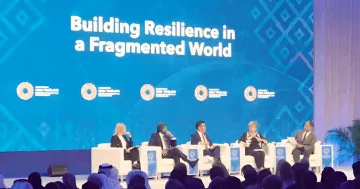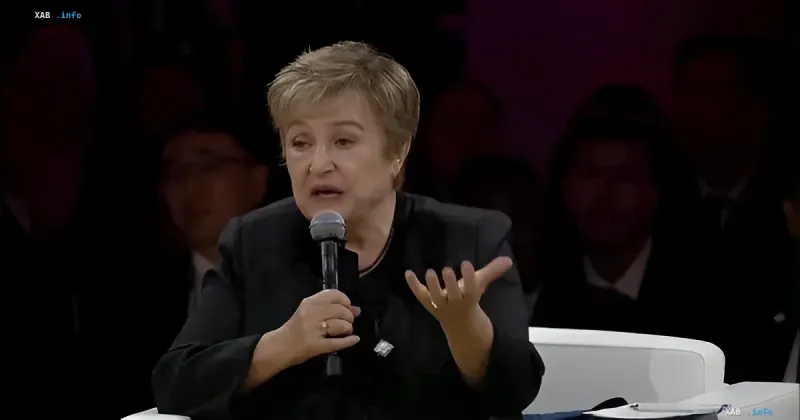
At the annual conference of the International Monetary Fund and the World Bank held on October 16 in Bangkok, Thailand, IMF Managing Director Kristalina Georgieva warned that the rapid development of artificial intelligence poses risks that could outweigh the technology's benefits if proper safeguards and ethical frameworks are not established. According to her, while AI is giving a boost to the global economy, it also represents a potential shock risk if productivity growth does not prove as rapid and strong as expected. "Without safeguards, risks could outweigh opportunities," the IMF chief stated, emphasizing that AI development needs not only security rules but also a sufficiently clear ethical foundation to guide the technology's application.
“Formula 1 Without Guardrails”
Georgieva compared the current pace of artificial intelligence development to Formula 1 race cars speeding along at high velocity without adequate guardrails. This imagery essentially became the central metaphor of her speech: the technology is developing faster than the infrastructure capable of keeping it within safe bounds. She also pointed out that for the benefits of AI to become accessible to a broad range of people, countries must first ensure fundamental conditions—stable electricity supplies, digital infrastructure, and appropriate regulatory systems. Without this base, technological progress risks becoming entrenched in a narrow segment and failing to translate into inclusive economic growth.
Business Self-Regulation and the Role of the State
The IMF chief emphasized that managing artificial intelligence cannot be exclusively the responsibility of governments, given the speed of change in the industry. In her estimation, a suitable mechanism should combine business self-regulation, the role of regulatory bodies, and public participation. According to Georgieva, both advanced AI economies—the US, China, and India—and countries participating in relevant supply chains must contribute to the development of common standards. Thus, the IMF is effectively proposing a multi-level governance model in which neither the state, corporations, nor civil society assumes sole responsibility.
Industry Stance and Washington's Priorities
This logic is also shared by Jack Clark, co-founder of American tech company Anthropic, who, according to Reuters, stated that "sensible standards" are necessary to build trust in AI and foster economic growth. He noted that the company regularly tests its systems, publishes results, and provides third parties with access to data for evaluation, but stressed that such measures should not depend entirely on the voluntary participation of enterprises. Artificial intelligence became one of the main topics at this year's IMF and World Bank meeting: the Fund previously warned that if the wave of investment in the sector slows down significantly, global economic growth and financial stability could face additional pressure. Meanwhile, as US Treasury Under Secretary Erin Brown stated, Washington aims during discussions to ensure that joint IMF documents more clearly reflect the economic opportunities unlocked by artificial intelligence.