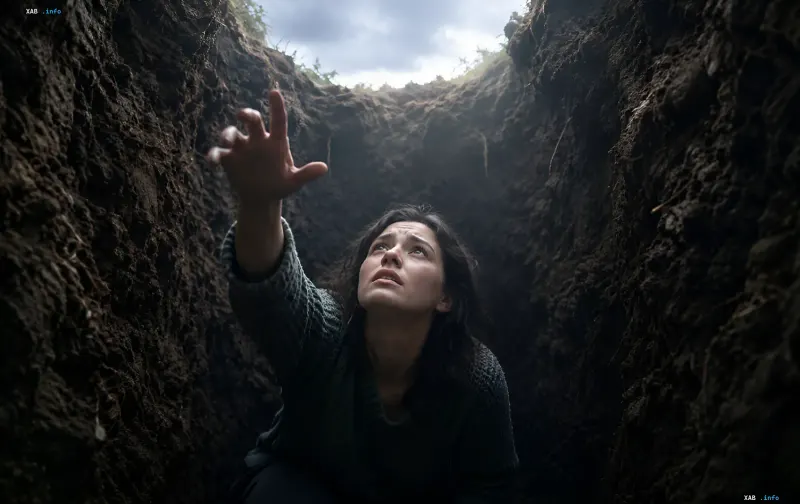
Dreams in which a person finds themselves trapped, stuck on a dangerous slope, or unable to climb out of a deep pit often leave a lingering sense of anxiety upon waking. In popular psychology and dream books, such scenarios are traditionally associated with internal obstacles, fears, and difficult life circumstances. Different schools of dream interpretation offer fundamentally different keys to the exact same image—a pit, a cliff, the impossibility of rising—and it is precisely this difference that is worth examining in more detail, drawing on the approaches of Gustav Miller, Sigmund Freud, and Carl Jung.
Miller: From Reckless Risks to Deep Sorrow
In the dream book of American interpreter Gustav Miller, set forth in his work «Ten Thousand Dreams Interpreted», a pit does not have a single fixed meaning: the interpretation depends on what exactly was happening in the dream. If a person merely peers into a deep pit, this image is linked to reckless risks in business and anxiety in personal life. Falling into a pit, according to Miller, symbolizes a more severe state—misfortune and deep sorrow. Thus, in Miller's system, dynamics matter: external observation and direct falling signify different degrees of involvement and different emotional consequences.
Freud: Blocked Movement as an Internal Conflict
Sigmund Freud did not create a universal guidebook assigning one constant meaning to every pit or cliff. In his work «The Interpretation of Dreams», he viewed dreams as «complex images» concealing internal desires, experiences, and conflicts. The psychoanalyst paid special attention to scenarios in which a person wants to do something but cannot: trying to run away, climb up, reach a needed destination, or leave a dangerous situation, yet their movements are seemingly blocked. In this context, a dream about getting stuck is read as an image of internal contradiction—the person strives for change, freedom, or a resolution, but simultaneously experiences fear, doubt, or psychological limitations. If an exit is visible in the dream but cannot be reached, the Freudian approach requires exploring what exactly is hindering one in real life and what feelings this obstacle evokes.
Jung: Loss of Support and a Period of Uncertainty
Carl Jung viewed dreaming as one of the ways the unconscious communicates a person's inner experiences and emphasized the importance of context in what was dreamed. In the Jungian approach, described in the work «On the Nature of Dreams», a deep pit, a cliff, or a place from which one cannot escape can be images of a psychological state when a person has lost their sense of grounding or cannot see a way forward. Such a scenario can be considered a symbol of a period of uncertainty, an internal crisis, or the necessity of facing experiences that previously went unnoticed. If a person is searching for an exit in a dream, this is symbolically linked to the desire to find a new direction, regain control over one's life, or better understand oneself.
Context Matters More Than the Symbol: The Role of Stress and Anxiety
The circumstances of the dream deserve special attention, as the meaning of the symbolic scenario changes depending on the details. Dreams about danger, falling, or the inability to escape do not necessarily have mystical significance: they can be connected with experienced stress, anxiety, fatigue, or situations that a person turns over in their mind before falling asleep. If such a scenario repeats, the focus should shift from the question «does this promise future troubles» to one's own emotional state: what is currently causing tension, where is support lacking, and which decisions seem difficult. It is precisely this shift in attention from prophecy to self-observation that unites the practical recommendations of all three approaches.
Thus, a pit and a cliff in a dream function not as a straightforward sign, but as a mirror of the current psychological state: Miller offers a ready scale of meanings from risk to sorrow, Freud sees a blocked desire and internal conflict in getting stuck, and Jung interprets the impossibility of escaping as a period of lost support and a request for self-understanding. In all cases, the context and emotional background of the dream remain key, rather than the image of the pit itself.