
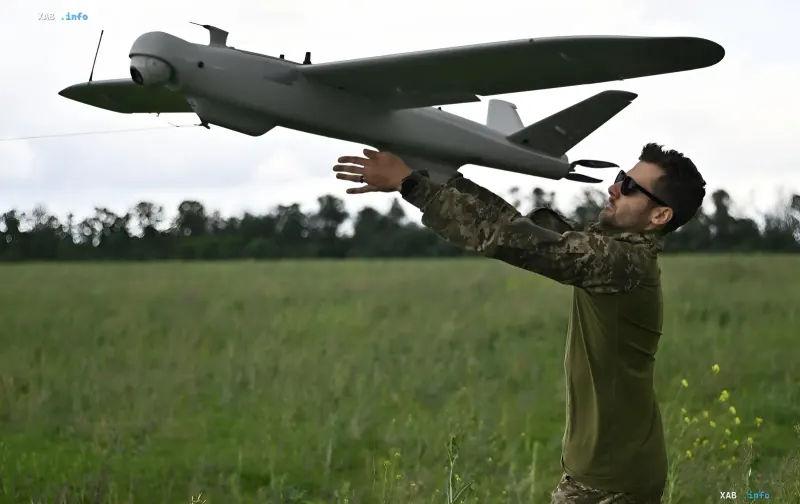
In the field of military technology, where the struggle for invisibility is becoming a key factor for survival, the Chinese company Star-Navi has made a breakthrough. A new series of specialized coatings, the XRAM-C Series, has hit the market, capable of radically changing the rules of the game for unmanned aerial vehicles. The main innovation lies in the form of release: it is not complex composites, but a standard spray available for application on any surfaces.
The Physics of Invisibility: How the Technology Works
The principle of operation of the new material is based on intercepting and neutralizing radio waves. Traditional surfaces reflect the radar signal back to the source, revealing the presence of the object. The XRAM-C coating works differently: it absorbs radio waves and converts them into thermal energy. As a result, the strength of the reflected signal drops, the effective scattering area (RCS) of the drone decreases, and it becomes practically invisible to modern radar systems.
Three Protection Options for Different Tasks
Star-Navi engineers took into account that radars operate at different frequencies and offered three specialized modifications of the coating:
- Version C105: Specialized for protection against X and Ku-band radars.
- Version C112: Designed to counter S and C-band systems.
- Version C113B: A universal option covering both frequency groups.
Availability and Ease of Application
One of the main features of the novelty is the democratic approach to implementation. The application method does not require complex production infrastructure or vacuum chambers. The coating is supplied in standard containers weighing 1, 5, and 10 kg, making the product accessible to a wide range of users, including field conditions.
The effectiveness of the material is confirmed by figures: a layer thickness of only 0.40–0.60 mm allows reducing the level of the reflected signal by 3–3.5 dB. This corresponds to approximately a twofold reduction in echo signal power, which is critical for flight stealth.
Strength and Durability Tests
Military equipment is subjected to extreme loads, and Star-Navi has conducted a series of rigorous tests. The coating demonstrates high resistance to external factors:
- The mass of the material does not exceed 1.1 kg per square meter, which minimizes the impact on aerodynamics.
- Properties are maintained at temperatures up to 250°C for 100 hours.
- The material is resistant to prolonged vibrations.
- Successfully passed 2000-hour tests in salt fog conditions, confirming the possibility of use on marine and coastal objects.
The appearance of such technologies on the market directly affects the tactics of drone application. It was previously reported that Ukrainian long-range drones demonstrate high accuracy when striking oil facilities and weapons factories in Russia, surpassing enemy "Shaheds" in effectiveness. The introduction of radar-absorbing sprays could make such strikes even more sudden and difficult to intercept.


