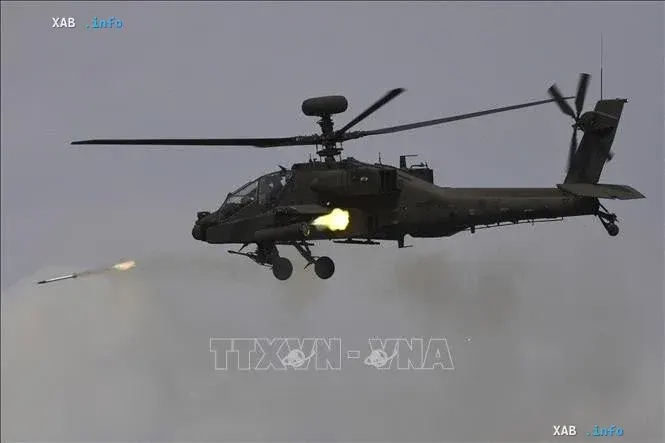
On October 14, the Israeli Ministry of Defense officially announced the signing of an agreement with the US corporation Boeing for the supply of 12 AH-64E attack helicopters, the newest modification of the Apache family. Tel Aviv has not disclosed the value of the contract, but Israeli media estimate the deal at approximately one billion dollars. Deliveries of the aircraft are expected in the early 2030s. This decision represents a major turnaround: just a few years ago, the General Staff of the Israel Defense Forces (IDF) was considering reducing the fleet of manned attack helicopters in favor of unmanned systems, and now Israel is not only preserving but expanding its helicopter forces.
Context: From Reduction to Expansion
Before the Hamas attack on October 7, 2023, the Israeli Air Force operated two Apache squadrons: the 13th (AH-64D helicopters) and the 190th (AH-64A), both based at the Ramon Airbase in the Negev Desert. Some of the aircraft had been in service for over 35 years, leading to rising maintenance costs. In the early 2020s, the General Staff discussed disbanding one of the squadrons, while a concurrently developing unmanned aerial vehicle program called into question the viability of investing in manned combat helicopters. However, according to the JNS news agency, by early 2024 the Air Force had already developed plans to expand its forces, including the purchase of two additional Apache squadrons. The slow response in the opening hours of the October 7 offensive and the need for direct ground support in Gaza became key arguments in favor of increasing the fleet.
Technical Characteristics of the AH-64E
The AH-64E helicopter is equipped with the AN/APG-78 Longbow fire control radar, advanced sensor systems, and manned-unmanned teaming technologies. According to reports, the new version of the Longbow radar features an increased detection range—from 8 to 16 km—as well as the added capability to engage maritime targets. The AH-64E is capable of controlling multiple UAVs, enabling reconnaissance and target identification without bringing the helicopter into a danger zone. The aircraft's arsenal includes AGM-114 Hellfire II air-to-ground missiles, Israeli Spike NLOS missiles with a range of over 25 km, Stinger air-to-air missiles, Hydra unguided rockets, and a 30 mm automatic cannon.
Connection to the US 30-Helicopter Package
The signed agreement came into effect nearly nine months after the US government approved a potential sale to Israel of up to 30 Apache helicopters for a total estimated cost of $3.8 billion. Currently, Tel Aviv has not announced plans to acquire the remaining 18 aircraft from the approved package. According to Israeli reports, Washington had pressured Israel to sign the agreement promptly, warning that otherwise other foreign customers might be given priority in deliveries.
Operation Thunder and the New Rapid Response Doctrine
In 2025, Israeli media reported the deployment of an Air Force plan named «Thunder», aimed at preparing for the threat of large-scale invasions from Gaza. According to YnetNews, the level of readiness for sudden invasions was increased by 2.5 times, encompassing requirements for attack helicopters, transport aircraft, UAVs, and fighter jets. Representatives of the Israeli Ministry of Defense stated that the acquisition of the AH-64E is a crucial step in enhancing the IDF's combat readiness amid multi-vector threats. Thus, helicopter aviation, which until recently was considered an «overheated» expense item, has once again become a priority area for the modernization of the Israeli armed forces.