
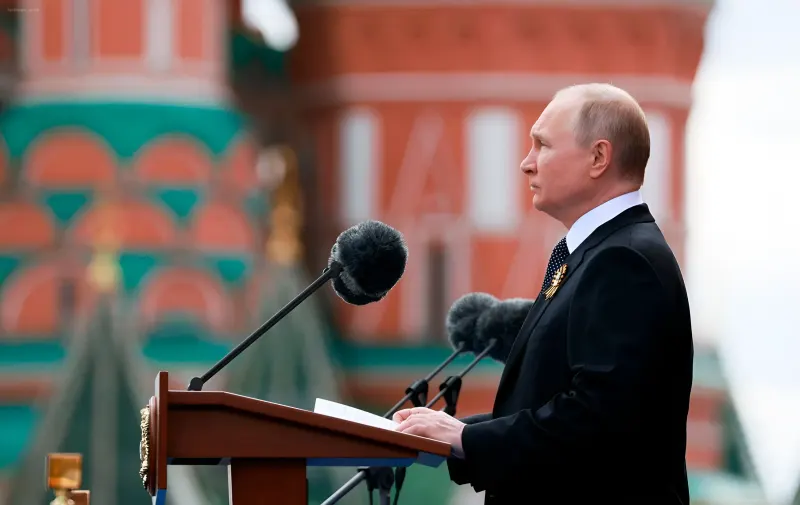
The large-scale missile strike on Kyiv that occurred on the night of May 24 was not merely a military operation but a direct consequence of political pressure on the Kremlin. Analysts from the Institute for the Study of War (ISW) concluded that Vladimir Putin's order to launch the attack was dictated by the need to "cover up humiliation" following the Victory Day parade on May 9, which sparked a wave of criticism.
The Psychology of Power: Demonstrating Force Instead of Defense
Prior to the start of the ceremonial events, Moscow threatened to attack Ukrainian "decision-making centers," including the use of the "Oreshnik" ballistic missile, in the event of provocations. However, Kyiv refrained from action. Experts believe these threats were initially a tool to mask problems with defending their own airspace and a method of intimidation.
Nevertheless, the strike followed the parade. According to ISW, this was an attempt by the Russian President to demonstrate strength and compensate for the negative assessments of the event. The attack violated the unwritten "spirit" of the three-day ceasefire, confirming that Moscow is ready to ignore agreements if they do not bring it political benefit.
The Illusion of Success Against the Backdrop of Frontline Failures
The domestic Russian context also plays a key role. Military bloggers, whose opinions are cited in the report, describe the strikes on Kyiv as largely symbolic and ineffective. Meanwhile, Ukraine continues to launch precision strikes on the enemy's logistics, while Russian troops show no significant progress in the spring-summer campaign of 2026.
The Russian command likely used the missile strike as a diversion to shift the attention of the domestic and international audience from failures on the front lines to the "might" of the Russian army.
The Cost of "Demonstrating Force": Destruction and Casualties
On the night of May 24, Russia launched 90 missiles, including the "Oreshnik," and 600 drones at Ukraine. Air defense forces managed to shoot down 55 missiles and 549 drones, but tragedies could not be avoided. As a result of the attack, two people were killed and 87 injured, including three children.
The strikes hit all districts of the capital. Residential buildings, schools, and a grocery market near the "Lukianivska" metro station were in the impact zone. Cultural objects were also hit: the Ministry of Foreign Affairs building, an art museum, and the "Chernobyl" museum.
Particular attention was drawn to the strike on Bila Tserkva in the Kyiv region, where, according to the Armed Forces of Ukraine, an "Oreshnik" missile also hit. Two men were killed in the shelling. A report from the scene, prepared by RBK-Ukraine, vividly demonstrates the consequences of this war crime.


