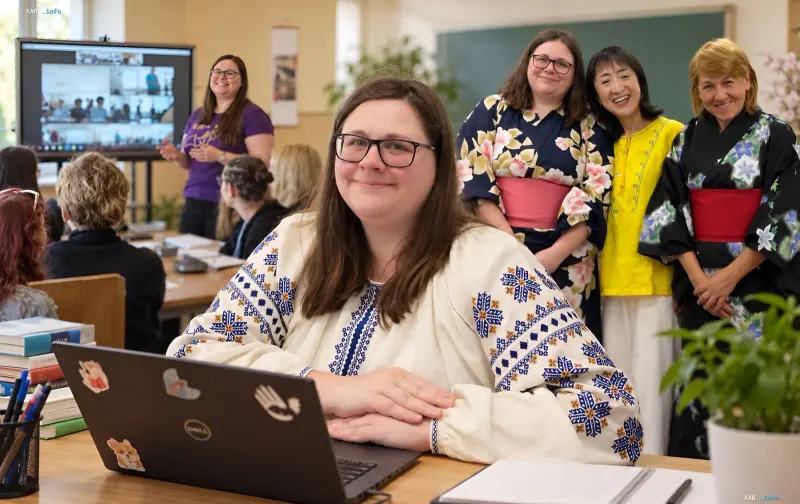
The Lviv School of Oriental Languages and Martial Arts "Budokan" has become a place where the Japanese language is taught not as a set of phrases from anime, but as a system requiring daily effort. In an interview with Styler, teacher Kateryna Filenko spoke about how teaching Japanese works in Ukrainian conditions: about salaries, burnout, students' stereotypes, and the experience of an educational trip to Japan. The conversation also touched upon the topic of learning the language through anime and why mere grades in a gradebook do not reflect a student's real level.
Salary: Accounting "Magic" and 12–17 Thousand Hryvnias
According to Filenko, there is no difference in pay between a Japanese teacher and a traditional foreign language teacher: "I receive as much as a regular foreign language teacher." The income amount, she explains, is formed from experience, weekly workload, certification and categories, as well as a number of coefficients calculated by accounting. "To be honest, I consider this magic. Once a year I look at my printout and immediately remember what a public school and Ukrainian salaries are," the teacher admits. Referring to RBC-Ukraine data, she names a range of 12–17 thousand hryvnias per month, clarifying that the amount fluctuates depending on bonuses, length-of-service allowances, the prestige of pedagogical labor, and the city budget. "I haven't calculated how much I'm paid for a single lesson in a long time, just so I wouldn't feel sad," she adds.
Fatigue, Not Anger: How Classes Are Held in Wartime Conditions
The teacher calls accumulated fatigue, rather than anger, the main burden: teaching is combined with the development of educational materials and bureaucracy. She highlights air raid alerts as a separate factor — the anxiety over whether a lesson can be held at all or if tasks will have to be explained in a shelter. It is especially difficult, she says, at the end of the semester when tests and final surveys accumulate, and part of the class misses lessons due to enemy drone flights, forcing topics to be combined. "A lot of various bureaucratic moments accumulate that need to be finished. And that takes a significant amount of time," Filenko notes.
Stereotypes About Japanese: Why Kanji Must Be Written Out
One of the persistent myths the teacher regularly encounters is transferring the experience of learning other languages to Japanese. "Someone learned English, but when studying Japanese, they don't always understand that you need to write out a lot, for example, kanji. If you don't write them out, you won't remember them and won't be able to reproduce them," she explains. Visually, signs can be recognized and understood by context, but correctly reproducing them becomes difficult when many accumulate and begin to get confused. Filenko emphasizes that Japanese belongs to a different category of difficulty than German with its cases and genders, and requires systematic daily work, not just getting used to the specifics of an Eastern language.
A Trip to Tokyo: Even Teachers Wrote Kanji Lists
The teacher provides a practical argument in favor of writing out characters from a summer trip to the Tokyo International Japanese School. "Even I, as a teacher, wrote out kanji there. Every day we wrote whole lists of words with kanji, and groups did this even at the highest levels of studying Japanese," she recalls. This example, she says, shows that the approach to language learning requires hard work and does not boil down to passive perception, no matter how attractive learning through anime or TV shows might seem.
Parents Who Dictate the Method
A separate topic of the interview is interaction with families. Filenko says there were cases when parents came with their own vision of how their children should be taught, knowing nothing about the methodology. In response, the school asks to be warned in advance about a visit so the teacher can bring the student's work and analyze it together with the parent. "At some point, I stopped taking part in discussions about teaching or reading them because it tired me out," the teacher says, reminding that participants in the educational process must comply with the Law of Ukraine "On Education" and take into account not only the rights but also the obligations of each party.