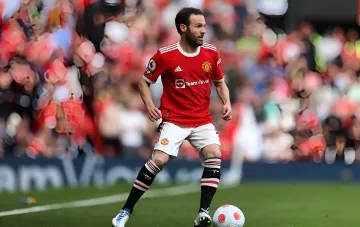

In football, there are players remembered for goals, records, and statistics, and then there are those whose play you remember as a work of art. Juan Mata belonged to the second category. The Spaniard concluded his career leaving behind not only an impressive collection of honors — a World Cup, European Championship, Champions League, and Europa League — but also a less obvious legacy: a reminder that football can be an act of creation. It is only a pity that for most of his career, his talent remained somewhat underrated.
The "Magician" called an artist
Calling a footballer an artist is a common journalistic device, but in Mata's case, this definition goes beyond a nice metaphor. The Spaniard's well-known nickname, "El Mago" or "The Magician," is merely a hint at the core of it. Mata perceived football not just as a competition to beat an opponent, but as a space for creativity. He belonged to a rare category of players capable of seeing things on the pitch that others miss: a short pause before a pass, an unexpected decision, a shift in the direction of an attack, an exquisite pass through several opponents. His football consisted of details. He was almost never the fastest, strongest, or most athletic on the pitch — his main weapons were intelligence, technique, and an understanding of the game.
Trequartista, doomed to the shadows
Despite his Spanish passport, Mata's best role is described by the Italian term trequartista — a player who links different units of the team and creates moments through imagination. This was precisely the kind of footballer he was, and that is why he was doomed to remain in the shadows: modern football actively crowds out this type of player, preferring versatility, physical power, and tactical discipline. After announcing his retirement, the official Premier League Instagram account posted Mata's highlights, and that video encapsulates all of Juan: no flashy tricks or slalom runs across half the pitch, but fantastic passes, ingenious ball controls, and incomparable vision.
Football as choreography
Mata's creative side found an extension beyond the pitch. In 2023, he joined the project The Trequartista: Art and Football United, realized alongside curator Hans Ulrich Obrist and artist Tino Sehgal as part of the Manchester International Festival. One of the central works was the performance This Entry, where participants combined football, dance, music, and movement, exploring the interaction of the body with objects and space. For Sehgal, football turned out to be extremely close to choreography: constant changes in body position, balance, direction of movement, and interaction between performers resembled a dance. Mata did not just become the face of the project — he helped conceptualize football as a distinct form of creativity, showing a keen interest in combining different worlds.
Beyond the pitch
The Spaniard pursued photography, and snapshots from his trip to India became part of an exhibition at the National Football Museum in Manchester. Even earlier, he joined the creation of Common Goal, an international initiative urging footballers, coaches, and other industry stakeholders to donate 1% of their income to social projects. For Mata, this was not an attempt to find a hobby outside of football, but a natural extension of his worldview: a person who searched for unconventional solutions on the pitch strived just as hard to step beyond the familiar outside of it.
The legacy of an underrated talent
Despite all his achievements, Mata was never the main star of his generation. Even in his most successful years, he was surrounded by players whose names echoed louder, and that is precisely why his story deserves special attention. He retired from professional football without leaving loud scandals behind, but leaving an example of how intelligence and technique can rival any physical power.