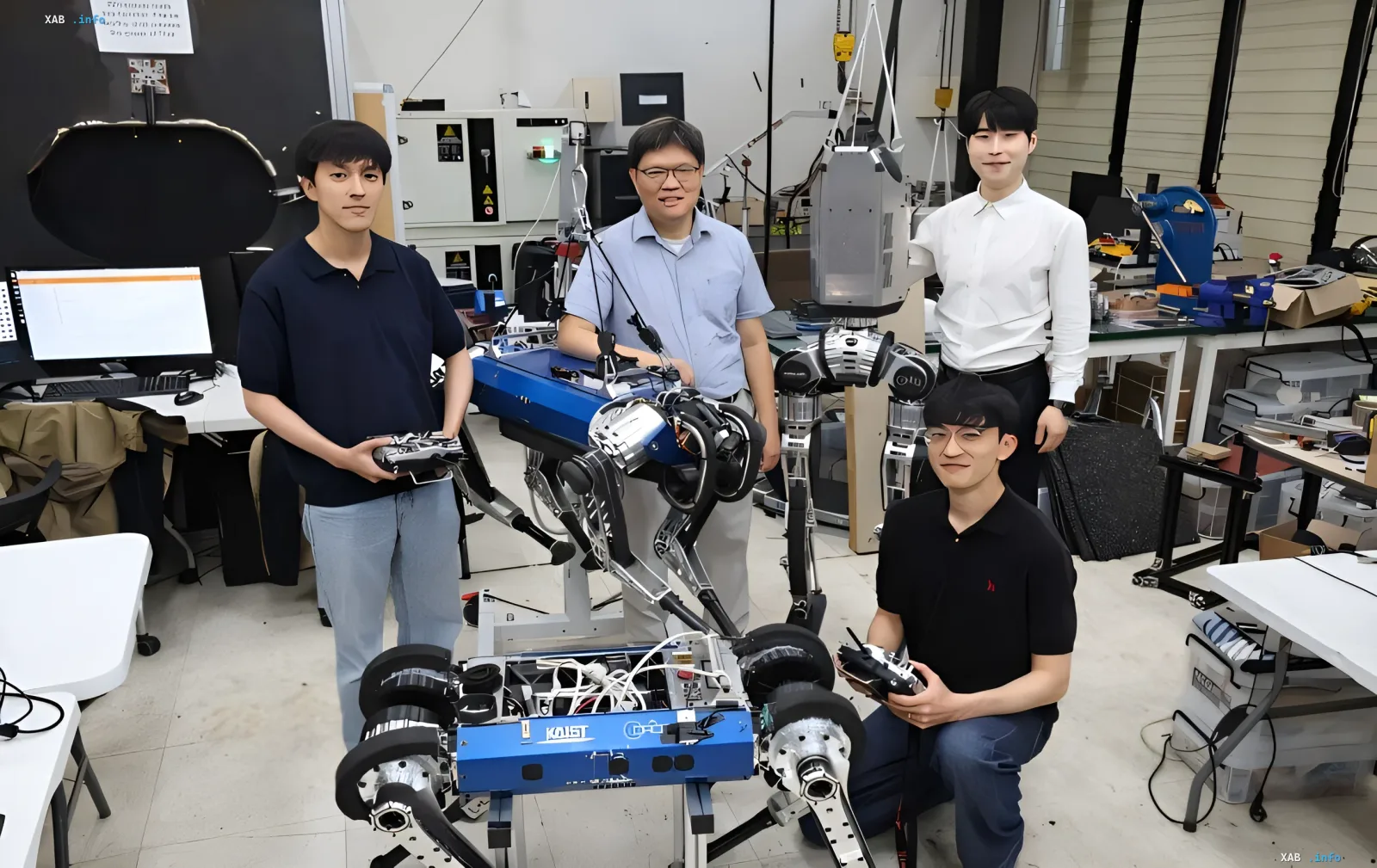
A breakthrough has occurred in the world of robotics that could radically change the application of autonomous machines in real-world conditions. Scientists from the Korea Advanced Institute of Science and Technology (KAIST) have developed a new artificial intelligence system that allows quadruped robots to independently choose the optimal mode of movement depending on the terrain.
The technology, described in the journal Science Robotics, addresses one of the main problems in modern robotics: the inability of machines to smoothly switch between different movement modes when encountering unpredictable obstacles.
The Problem of "Rigid" Algorithms
Quadruped robots are traditionally considered more maneuverable than wheeled counterparts, especially on rough terrain. However, their potential was often limited by software. In real conditions—whether a forest trail littered with trees or a ruined building—obstacles appear chaotically.
Previously, engineers had to create separate algorithms for each type of movement: walking, running, or jumping. This made natural switching between styles impossible. The robot either could not accelerate on a flat section or lost stability when trying to quickly overcome an unevenness.
APT-RL Technology: Learning Without Borders
To solve this problem, scientists applied the APT-RL method (Action Pretrained Transformer-based Reinforcement Learning). In translation, this means "reinforcement learning based on a pretrained action transformer".
The essence of the method is that the robot first masters basic motor skills and then learns to freely combine them depending on the situation. This allows the machine not just to perform learned movements, but to adapt them to current conditions.
Simulation Instead of Reality
A key aspect of the development was the speed of data generation. Instead of spending months filming the movements of real animals using expensive sensors, scientists used computer modeling.
In just eight minutes, a computer generated 15.5 hours of virtual training data. Based on physical movement models and trajectory calculations, the AI went through thousands of virtual trials and errors, learning to choose the optimal behavior strategy in three-dimensional space.
Tests in the Wild
The new control system was tested on KAIST's proprietary HOUND robot. The machine is equipped with a 3D depth camera and a LiDAR laser rangefinder, allowing it to scan the terrain and instantly adapt its movements.
Tests were conducted not only in the laboratory but also in natural conditions—on the campus grounds and in the forest. The robot had to overcome tree roots, pits, and fallen leaves.
The results exceeded expectations:
- The robot demonstrated a record instantaneous speed of 6 meters per second (about 22 km/h).
- The machine independently changed its gait from a trot (diagonal step) to a gallop or jumps depending on the complexity of the route.
- The control system allowed the robot to maintain balance even on the most difficult sections.
The Future of Autonomous Robots
Developers are convinced that the universal controller they created will become a basic technology for future physical robots with AI. Such machines can be deployed for industrial facility inspections, military missions, and disaster relief, where terrain conditions are often unpredictable and require high adaptability.


