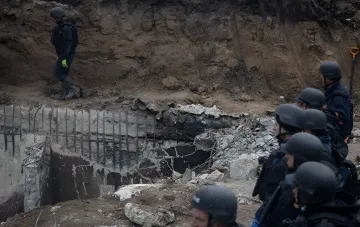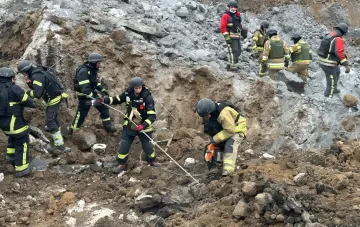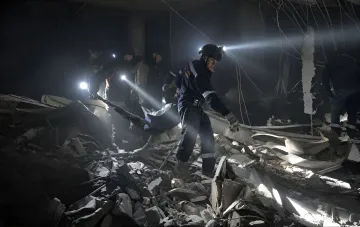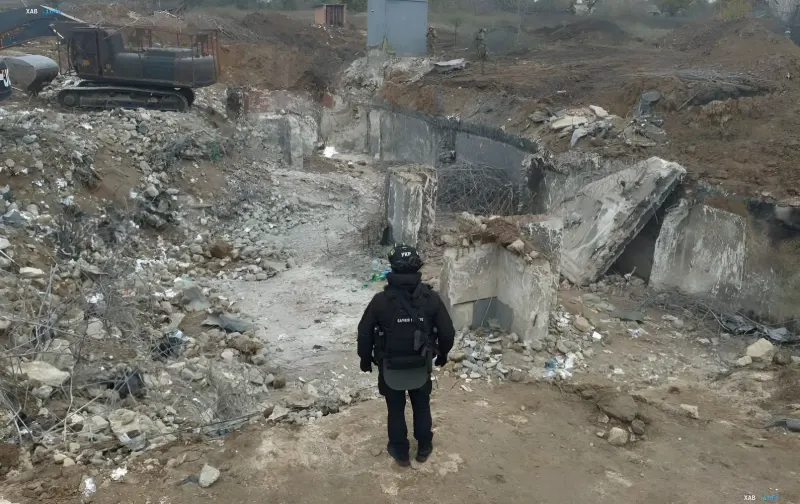
In Kamyshevakha, Zaporizhzhia region, search and rescue operations at the site of the November 2 Russian guided aerial bomb strike were officially completed on November 16, 2026. This was announced by the Minister of Internal Affairs of Ukraine, Ihor Klymenko (Ivan Vyhivskyi), and the Head of the Zaporizhzhia Regional Military Administration, Mykhailo Semykin. Following the two-week operation, the deaths of 72 people have been confirmed, while the fate of four residents remains unknown.
Scale of the tragedy: One of the heaviest strikes of the entire war
According to the Minister of Internal Affairs, the shelling of Kamyshevakha on November 2 became one of the most tragic episodes of the full-scale war. As a result of the attack, 72 people were killed — including rescue workers, police officers, employees of the gymnasium and TsNAP, municipal workers, and medical staff. Vyhivskyi specifically noted the death of a schoolteacher who came to the shelter every day to conduct online lessons for children who had left the hromada. Head of the Zaporizhzhia RMA Mykhailo Semykin called the incident 'the most terrible strike on the Zaporizhzhia region in terms of the number of victims and one of the most terrible in Ukraine.'
Two weeks under fire: Conditions of the rescue operation
Search and rescue operations lasted for two weeks and took place amid the constant threat of new attacks. During this period, Russian troops shelled the settlement eleven times, with nine strikes hitting the rescue operation site directly. As a result of this shelling, three police officers and four rescue workers were injured, and special equipment was damaged. Engineering equipment and cynologists were deployed to clear the rubble and locate the bodies of the victims, and experts conducted dozens of DNA tests to identify the deceased.
Chronicle of the strike: What happened on November 2
On November 2, 2026, Russia struck Kamyshevakha twice. The targets of the attack were a school, where humanitarian aid was being distributed at the time, and a shelter. President Volodymyr Zelenskyy previously reported that the enemy dropped nine aerial bombs: first targeting people who had gathered for humanitarian aid, and then targeting the rescuers and police officers who arrived at the scene. Thus, the strike targeted both civilians and the emergency personnel working at the site.
Consequences and current condition of the victims
According to Mykhailo Semykin, four wounded individuals continue treatment in medical facilities, while a fifth victim — a woman — died in the hospital. Four people are still listed as missing, and their fate remains undetermined. Semykin wished the survivors 'strength and recovery' and emphasized that while the search operation is complete, the question of the four missing persons remains open.
Authorities' reaction and public resonance
In his statement, Ivan Vyhivskyi expressed condolences and wrote: 'Eternal memory to all those who died as a result of this brutal strike.' The statements from the Ministry of Internal Affairs and the RMA were released simultaneously and distributed by a number of Ukrainian news agencies, including RBC-Ukraine, Ukranews, Slovo i Dilo, and Obozrevatel. All sources unanimously confirm the key figures: 72 dead, 4 missing, and 11 shellings of the settlement during the two weeks of rescue operations.