
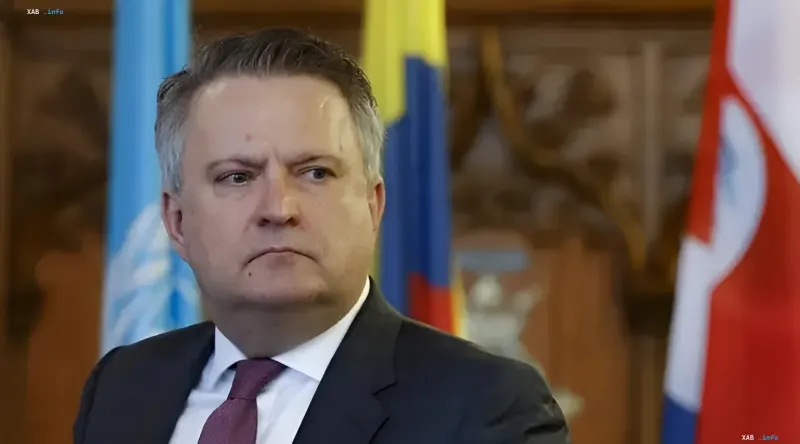
The diplomatic landscape surrounding the Ukrainian settlement has undergone significant changes. The Office of the President of Ukraine (OPO) has officially reviewed the status of contacts held in Istanbul in 2025. First Deputy Head of the OPO Serhiy Kislitsa, in an interview with the RBC-Ukraine agency, gave a strict definition to these events: they were not full-fledged negotiations, but rather a preliminary exchange of views.
Distinguishing concepts: "Exchange of views" vs. "Official negotiations"
The key thesis of Kyiv's position lies in the clear demarcation between simple contacts and legally significant dialogue. According to Kislitsa, a genuine international dialogue was initiated only from 2026. This became possible exclusively due to the involvement of the United States of America as mediators.
The Ukrainian side categorically rejects attempts by the Russian delegation to interpret the 2025 meetings as a direct continuation or resumption of the negotiation track that existed in the spring of 2022. Kyiv points out that the geopolitical conjuncture and the regulatory framework have changed so much that a return to previous framework agreements without their deep revision is impossible.
The American factor as a condition of legitimacy
The institutional context of the 2025 meetings was limited by the absence of a US delegation. Serhiy Kislitsa explained that the Ukrainian side acted in strict accordance with the directives of President Volodymyr Zelenskyy. A key condition for Kyiv was the presence of US administration representatives as international guarantors.
Without the physical participation of the American side, the status of the meetings in Istanbul was normatively limited to the fixation of polar positions. This allowed Ukrainian diplomacy to avoid creating a precedent where contacts without security guarantees could be interpreted as the beginning of a peace process.
The impact of the Middle East on the settlement schedule
The dynamics of events in the first half of 2026 depended directly on the foreign policy priorities of Washington. Starting from the end of February 2026, the White House temporarily reduced the intensity of its participation in the Eastern European track. The reason was the need to redirect diplomatic and intelligence resources to curb the crisis in the Persian Gulf region.
The military-political confrontation between the US and Iran, which lasted more than four months, created serious constraints. Periodic escalations around the Strait of Hormuz did not allow American mediators to conduct parallel multi-vector consultations. Full stabilization of the US mediation mission and synchronization of positions became possible only within the framework of international summits in the summer period of 2026.
Chronology and status of diplomatic stages
To understand the current situation, it is important to distinguish between stages of diplomacy that have fundamentally different statuses:
- 2022 Period: Primary Istanbul rounds under the auspices of Turkey. Currently, they have lost legal force.
- 2025 Period: Working meetings in Istanbul. Classified as an "exchange of views" in a consultative format without US participation.
- Spring 2026: Slowing down of the diplomatic track due to the escalation of the conflict in Iran and the US administration's focus on the Middle East.
- Summer 2026: Start of a coordinated negotiation process with full US mediation.
Legal frameworks and guarantees
Official spokesmen of the Ministry of Foreign Affairs of Ukraine and the Office of the President emphasize that any further steps to form a roadmap for a peaceful settlement are carried out in strict accordance with the Law of Ukraine "On the Legal Regime of Martial Law" and decrees of the Supreme Commander-in-Chief. This excludes the possibility of backroom agreements without the public fixation of obligations of guarantor countries.
The international legal regulation, in particular the 1969 Vienna Convention on the Law of Treaties, determines that only processes formalized with appropriate mandates and protocols with the participation of all agreed parties have legal force. It is this principle that formed the basis for the reclassification of the Istanbul meetings of 2025.


