
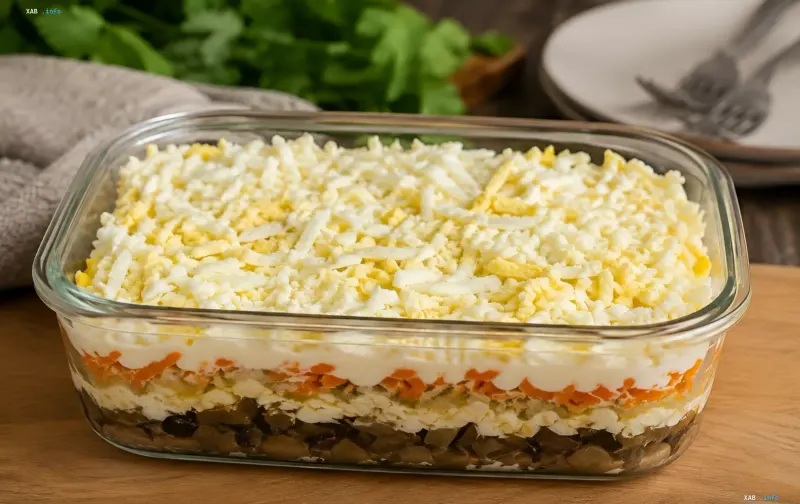
At first glance, the layered appetizer in the glass container is easily mistaken for a meat salad: a delicate white top, bright orange flecks, dense layers. But the base of the "Konotopsky" salad is a completely different ingredient. According to the recipe that food blogger Anastasia Tsarova published on Instagram, the main ingredient is eggplant with garlic, complemented by a sauté of onion and carrot, boiled eggs, and cheese. That is exactly why the finished dish looks like a classic holiday appetizer yet turns out delicate and rich in taste, despite its vegetable base.
What hides under the top layer
The salad is assembled in layers, and each one serves its own function. At the bottom are eggplants sautéed until soft with garlic, which provide a dense but not greasy foundation. On top goes the onion-and-carrot sauté, then boiled eggs and cheese, and the final layer is formed from grated egg and cheese, creating the familiar "white" top. This structure allows the appetizer to hold its shape when sliced and to decorate the table without falling apart on the plate.
Three nuances that determine the taste
The first rule is to cool the ingredients completely: the eggplant, carrot, and onion must be cooled before assembly, otherwise the mayonnaise thins out and the salad becomes watery. The second is not to overdo it with vegetable oil, because eggplant actively absorbs it and can easily turn a delicate layer into a greasy base; it is enough to sauté the vegetable until soft without excess fat. The third is to let the salad rest in the refrigerator for at least an hour: during this time the layers will soak through, the taste will become more uniform, and the appetizer will hold its shape better.
Why eggplant absorbs oil
The spongy structure of the vegetable explains its "thirst" for fat. Specialists at the University of Illinois Extension describe the process simply: under the effect of heat, air leaves the cells, and vegetable oil takes its place. To reduce fat absorption, eggplant can be pre-salted, left for a while, and well patted dry. Representatives of the Purdue University Extension add that the amount of oil in the pan should be controlled, and a non-stick surface allows vegetables to be sautéed with less fat. An alternative to frying is baking in the oven, which requires little to no oil at all.
Contradictory data
There is one inconsistency here that must be stated honestly. The recipe is indeed widely circulated under the name "Konotopsky," however, there is no reliable history of the dish's origin or a confirmed source linking it to the city of Konotop in open materials. Therefore, calling the appetizer a "traditional dish of Konotop" without a verified account of its origin is incorrect: the name is more of a folk or authorial character, rather than the status of a documented regional recipe.
Bottom line: the "Konotopsky" is an affordable, layered appetizer in which the main ingredient is hard to recognize after cooking. Following three simple rules — cooling, moderate oil, and time to rest — turns a set of ordinary products into a delicate salad that is fully capable of becoming the centerpiece of a holiday table.