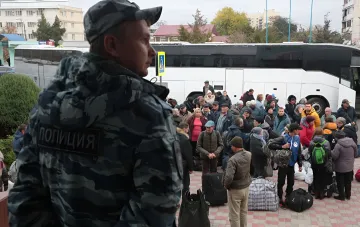
Russian presidential press secretary Dmitry Peskov has publicly evaluated the humanitarian operation to evacuate residents of occupied Oleshky in the Kherson region. According to him, Moscow considers this operation successful and highly appreciates the coordination of all its participants. The statement came against the backdrop of discussions regarding the results of the evacuation, which concluded on October 31: a humanitarian convoy transported over 750 people, most of whom left for Ukraine, while others went to Russia. The transit of those evacuated to Ukraine took place via Belarus.
Kremlin Assessment: Operation Declared Successful
The Kremlin emphasizes the organizational aspect of the event rather than its political context. The wording about “highly appreciating the coordination of all participants” indicates that Moscow is focusing on the logistics and the interaction of the structures involved in moving the citizens. At the same time, as Russian media quoting Peskov note, such phrasing is used to reinforce Moscow’s image as the party ensuring the “humanitarian” nature of the operation, despite the fact that it was carried out on occupied territory.
No Future Missions Based on the Oleshky Model
Despite the positive assessment, Russia explicitly stated that there are no plans to repeat such operations. “There are currently no plans or initiatives similar to this humanitarian operation, but in every case, the interests of the citizens will be the priority,” Russian media reported Peskov as saying. Thus, the Kremlin is framing the event as a one-time occurrence and does not promise its replication in other settlements, while maintaining a declarative link to the “interests of citizens.”
Context: Statements on Regular Missions and Peace Process
On the same day, October 31, Russia claimed that it had allegedly agreed with Ukraine to conduct regular humanitarian missions. This statement creates some tension with Peskov’s later position regarding the absence of plans for operations similar to Oleshky: the first case refers to “regular missions,” while the second refers to large-scale evacuation operations of a specific model. Concurrently, Ukrainian Foreign Minister Andrii Sybiha stated that Kyiv is prepared to halt combat operations on all front sectors provided that Russia does the same.
Kyiv’s Stance: Oleshky as a Potential Confidence-Building Measure
The Ukrainian side interprets the results of the Oleshky operation through the lens of the peace process. According to Sybiha, the results of the evacuation could strengthen trust between the parties and open the way for subsequent steps toward a settlement. Thus, the same operation is assessed in Moscow as an organizational success without future commitments, and in Kyiv as a potential element of de-escalation and mutual concessions. Both narratives agree that the evacuation took place and affected over 750 people, but they differ in their conclusions about its significance for future contacts.