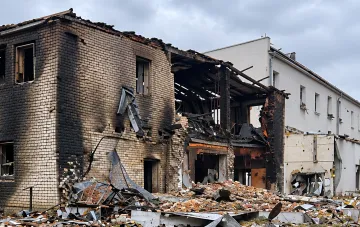
On the night of November 20, 2026, Russia launched a massive ballistic missile strike on Kyiv. According to preliminary data from the Department of Cultural Heritage Protection of the Kyiv City State Administration (KCSA), damage of varying degrees was recorded on eight cultural heritage sites and iconic landmarks of the capital. Among those affected are St. Michael's Golden-Domed Cathedral, the Yevhen Paton Bridge, the Landscape Alley, the Mykhailo Drahomanov University building, historical estates in Podil, the museum at the "Motherland" monument, and the Dutch Embassy building. Specialized services, heritage conservationists, and expert commissions are already working at all these locations, conducting initial assessments and preparing damage reports.
Scale of the attack and consequences for the city
According to reports previously cited by RBC-Ukraine, seven people were killed in the night strikes, 17 more were injured, and 16 were hospitalized. Fires broke out in several districts of Kyiv. Damage was inflicted on three bridges across the Dnieper: the Podil-Voskresensky, the Darnytskyi, and the Southern Bridge. Critical infrastructure objects were affected: power, heating, and water supply outages were observed in parts of the city. Traffic between the banks of the Dnieper was hindered, and city authorities urged Kyiv residents not to use private or public transport unless absolutely necessary.
St. Michael's Golden-Domed Cathedral and monastic buildings
Among the most prominent losses is St. Michael's Golden-Domed Cathedral, the main temple of the monastery of the same name. The temple was reconstructed in 1997–1998 on the site of a 12th-century shrine destroyed in the 1930s. The building of the Kyiv Municipal Bureau of Technical Inventory at 4 Tryokhsviatytelska Street, a former pilgrim hotel for St. Michael’s Monastery and a local architectural monument, was also damaged.
Drahomanov University and Podil monuments
The strikes damaged the main building of the Mykhailo Drahomanov Ukrainian State University — a 1970s Soviet modernist structure. In Podil, the Nechaiev Estate, also known as the Vyshnevsky House, at 7 Kontraktova Square, was damaged. This is one of the oldest surviving residential buildings in Kyiv: built in 1798, rebuilt in 1860, it survived the great Podil fire of 1811.
Museum at the "Motherland" and the Landscape Alley
The blast wave shattered the glass of the National Museum of the History of Ukraine in the Second World War, located near the "Motherland" monument. Damage was also recorded on the Landscape Alley, which is laid out on the site of the defensive ramparts of the Upper City dating back to the 10th–13th centuries. Thus, the strike affected both museum and archaeologically significant sites linked to Kyiv's ancient history.
Paton Bridge and the Dutch Embassy
The Yevhen Paton Bridge across the Dnieper was added to the list of affected sites. Opened for traffic in 1953, it is a monument of architecture, urban planning, science, and technology of local significance. Damage was also recorded at the Embassy of the Kingdom of the Netherlands in Ukraine on Kontraktova Square, 7. The coincidence of the embassy's address with the Vyshnevsky house on the same square highlights the concentration of historical and diplomatic objects in this part of Podil.
Work of specialized services and assessment of consequences
Specialized services, heritage conservationists, and expert commissions are working at all eight sites. Experts are conducting initial surveys, recording damage, and drafting relevant reports. According to the KCSA, the assessment of the attack's consequences is still ongoing, and information about the nature and volume of damage will be updated as expert evaluations are completed.