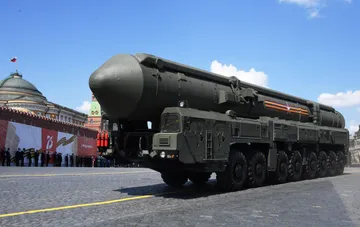

In the night of Thursday, September 24, 2026, the Russian armed forces carried out a ballistic strike on Kyiv. This was reported by the Ukrainian Air Force and the Kyiv City Military Administration (KCMA), citing RBC-Ukraine data. A "red alert level" — the highest category of missile threat — was declared in the capital. Kyiv residents were urged to immediately move to the nearest shelters. The Ukrainian Air Force detected a threat from ballistic weapons launched from the territory of Russia's Bryansk Oblast. This confirms Moscow's systematic practice of using long-range missiles against Ukrainian cities, making every night potentially lethal for the civilian population.
Response from City Authorities and Initial Consequences
The head of the Counter-Disinformation Center, Andrii Kovalenko, confirmed in a public statement: "The enemy is attacking Kyiv and the Kyiv region." The capital's mayor, Vitali Klitschko, reported that medical teams had been dispatched to the Solomianskyi district of Kyiv, and later added that medics were also being sent to the Sviatoshynskyi district. This indicates that the consequences of the strike — debris, fires, or injuries — have been recorded in at least two administrative districts of the city. At the impact sites, according to available data, fires broke out, requiring the work of fire and rescue services.
Context: A Series of Strikes on the Capital
The night ballistic attack on September 24 was a continuation of a series of intense strikes on Kyiv. The day before, on September 23, two people were killed as a result of enemy drones and the fall of their debris in the Darnytskyi and Solomianskyi districts. In total, as of that time, 36 people were known to have been injured as a result of strikes on the capital. On the morning and during the day of September 23, the aggressor used drones against a gas station, a business center building, an office building, the premises of a pharmaceutical enterprise, and facilities near the Central Railway Station. A landmark object damaged that day was the former Zhydelnozhkyi (Railway) market "Shayba" in the station area, where a large fire broke out as a result of a hit.
Counter-Disinformation Center Warning and Scale of the Operation
The Counter-Disinformation Center had previously warned about Russia preparing a ballistic strike on Ukrainian territory, indicating that the September 24 attack was not spontaneous but part of a pre-planned operation. According to TSN, alongside the ballistic missile heading toward Kyiv and a number of regions, groups of drones were moving, indicating the combined nature of the attack: the missile delivers the main strike, while drones distract air defense and attack auxiliary targets. President Volodymyr Zelenskyy, according to 24tv, commented on the strike, linking it to Moscow's attempt to show strength against the backdrop of unprecedented international sanctions imposed on Russia.
Contradictory Data
No significant discrepancies in the key facts were found in the provided sources: all parties — the Ukrainian Air Force, the KCMA, the Counter-Disinformation Center, and Mayor Klitschko — unanimously confirm the fact of the ballistic attack in the night of September 24. However, in the open data at the time of publication, the exact number of casualties specifically from the September 24 ballistic strike is absent (the figure of 36 injured and 2 killed refers to the events of September 23). It is also not specified whether the missile detonated over the city or fell on a specific object. These details may be revised as official reports come in.
Assessment of the Situation
The use of ballistic missiles against Kyiv, combined with massive drone attacks, demonstrates Russia's sustained tactic: a multi-vector strike that overloads the air defense system and maximizes psychological pressure on the civilian population. The declaration of a "red alert level" and calls to take shelter have become almost a daily practice for Kyiv, which raises questions about the effectiveness of current air defense systems and the need to rapidly strengthen defensive capabilities. For the capital's residents, every evening turns into a wait, and infrastructure losses — from markets to pharmaceutical enterprises — accumulate, worsening the humanitarian crisis in the city.