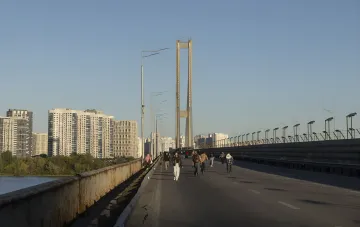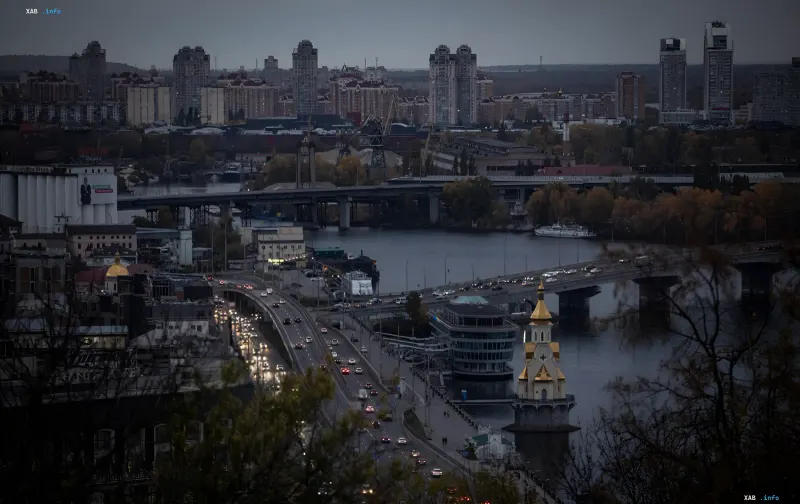
In Kyiv, on the night of November 17, Russia launched a ballistic missile attack on the capital, resulting in damage to the Northern and Southern bridges, as well as critical infrastructure facilities. Traffic on both crossings was initially completely blocked, however, by the evening of November 17, it was partially restored. By the morning of November 18, city authorities established a functional but limited transit scheme: specific rules apply to each bridge, and temporary restrictions, including reversible traffic and air raid alerts, have been introduced on other crossings.
What happened on the night of November 17
According to RBC-Ukraine, late in the evening on November 16, ballistic missiles damaged the structures of the Northern and Southern bridges, causing traffic to be completely halted. The strikes also hit critical infrastructure: power outages affecting water and heat supply occurred in parts of Kyiv. Two people were killed in the attack. Damage to ground infrastructure led to the suspension of trains on the 'green' metro line section between 'Osokorky' and 'Chervonyi Khutir': trains are now operating separately—on the underground section between 'Syrets' and 'Vydubychi' and the ground section between 'Osokorky' and 'Chervonyi Khutir'.
Traffic scheme for bridges on November 18
On the Southern bridge, vehicles weighing up to 10 tons and public transport up to 18 tons are permitted; however, passage from the right bank to the left remains closed, and vehicles are admitted at regulated intervals. On the Northern bridge, public and special transport use the far-right lane in both directions, while passenger cars and transit freight traffic are prohibited. On the Podilsko-Voskresensky bridge crossing, traffic from the left to the right bank is temporarily limited for approximately 15 minutes after an air raid alert begins. The Darnytskyi bridge and the Metro bridge are open without restrictions, while the E. Paton bridge operates on a reversible scheme: from 6:00 to 16:00, traffic flows from the left bank to the right, and from 16:00 until midnight, in the opposite direction.
How the city offsets restrictions
To facilitate movement between the banks, from November 18 to 20, the Kyiv Ring Electric Train is introducing 16 additional daily trips during morning and evening rush hours; trains run on the Pozniaky — Darnytsia — Vydubychi routes and back. In addition, on November 18, automated traffic violation recording systems were temporarily turned off on the Northern and Southern bridges—the Patrol Police cited safety reasons and technical circumstances.
Context: repetition of the scenario
These restrictions are not an isolated case. As previously reported, in October, after a series of strikes on the Southern and Northern bridges, the city military administration introduced a 'shuttle' regime with extra Kyiv City Express train trips between the banks. The current scheme with 16 daily shuttles and reversible traffic on the Paton bridge continues this logic: with key crossings damaged, the city redistributes traffic flow to the remaining bridges and reinforces rail transport during peak hours.