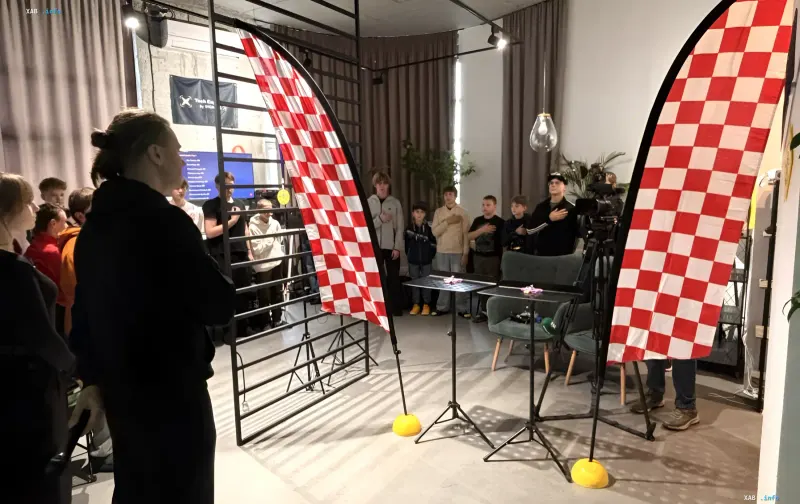
Kyiv hosted the "Micro-Drone Games" competition, an event involving children aged 6 to 17 whose parents are fallen heroes, active-duty service members, or veterans. The event was organized by the NGO "Mercy and Health" and the Free Sky school as part of a joint STEM education project. This was reported to RBC-Ukraine by Ekaterina Bogadelnikova, Director of the NGO "Mercy and Health," and Sergei Tkachuk, co-founder of the Free Sky school.
Competition Format and Participant Preparation
The competitions took place in a small indoor space where young pilots demonstrated their micro-drone piloting skills: changing flight altitude, flying through set frames and a tunnel. According to Ekaterina Bogadelnikova, the "Micro-Drone Games" marked the season opener for the engineering and technology school students. The children had been preparing for the event for a long time, studying engineering, technology, and 3D printing. A significant portion of the coverage about the competition's progress was published by the students themselves.
Civilian Applications of Drones as a Career Path
Sergei Tkachuk, co-founder and instructor at Free Sky, emphasized that the school focuses children on the civilian applications of unmanned aerial vehicles. "In the civilian sphere, there is incredible demand for drone usage. And in the future, this opens the path to any profession where drones are used. Video and photography, the agricultural sector, delivery—a bunch of different things," he explained. According to him, the curriculum includes not only flying but also courses in 3D printing and engineering. Training is structured in stages: from simulators to piloting real drones and doing engineering work. Many students assemble and configure devices independently, helping their peers.
Last Season's Results and Teaching Methodology
Last year, six Free Sky students participated in nationwide competitions: five reached the semifinal, and three made it to the final. A student named Nazar, who came to the school "from scratch," became the champion of Ukraine. Tkachuk shared that he bases his teaching methodology on his own musical education—he plays the trumpet and applies the principles of music education to working with drones. Some former students have already entered colleges majoring in unmanned systems and engineering, while others now work at the school itself as engineers and instructors.
The Role of NGO "Mercy and Health" and the "Summer Without War" Project
Ekaterina Bogadelnikova noted that the organization deals with the physical and psychological rehabilitation of active military personnel, veterans, and their family members. As part of supporting the families of fallen, captured, and missing service members, the "Summer Without War" project is active. Over four years of operation, more than 6,000 children have been sent to summer camps, with 1.5 thousand in the current summer season. Currently, the organization is developing its educational direction because, according to Bogadelnikova, STEM schools and the defense-tech sector in Ukraine are growing rapidly.
Call for Long-Term Business Support
The Director of the NGO "Mercy and Health" urged socially responsible businesses to join the project. According to her, by investing resources in children's education, the organization builds human capital. "We believe that the best thing we can give to children who have lost a parent or are waiting for them from captivity is to support their health and give them the opportunity to get a quality education," Bogadelnikova emphasized. She also noted that support must be long-term: "Episodic, targeted support, congratulations on the New Year and St. Nicholas Day—that's all wonderful, but we want to support these children on their professional path and give them the opportunity to master new fields, namely engineering and technology."