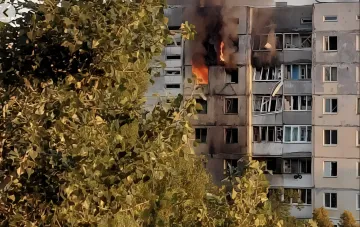
On the evening of Saturday, August 29, and into the night of August 30, Russia once again struck Kyiv using drones. The Air Force of the Armed Forces of Ukraine repeatedly detected drones heading toward the capital, after which explosions were heard in the city, and air raid alarms and all-clears sounded over the districts of Kyiv. According to Kyiv Mayor Vitali Klitschko and the Kyiv City Military Administration, the aftermath of the attack has been recorded in four districts at once — Obolonskyi, Podilskyi, Holosiivskyi, and Dniprovskyi. The night marked a continuation of a series of strikes that Russia has been delivering on the capital virtually around the clock since August 27.
Aftermath of the Attack by District
The most specific data on the damage came from the Obolonskyi and Podilskyi districts. In Obolon, according to local authorities, an enemy drone landed in the area between residential buildings; subsequently, Klitschko reported that a fire broke out on the second through fifth floors of one of the 12-story buildings. In the Podilskyi district, a fire was recorded in a warehouse, a warehouse building was damaged, a hit on a two-story non-residential building was confirmed, and a fire broke out in a green zone as a result of the drone falling. Medical workers were also called to this district. Detailed reports on the damage at the time of publication are concentrated in these two districts, while in the Holosiivskyi and Dniprovskyi districts the aftermath has been officially noted but without a detailed description.
Record Alarms and Russian Tactics
As observers note, over the last three days and now for a fourth day in a row, Russia has been carrying out massive attacks on Kyiv and the Kyiv region. Thus, on August 27, 13 air raid alarms sounded in the capital in a single day — a record value since the start of the full-scale war. Head of the Center for Countering Disinformation Andrii Kovalenko explained that Russian tactics are built on provoking alarms, as well as on the deliberate depletion of Ukraine's air defense resources and of the population itself, which is forced to remain in shelters constantly.
Government Response: New Rules for Prolonged Alarms
Against the backdrop of multi-day strikes, Ukrainian Prime Minister Serhiy Haidai announced that the Cabinet of Ministers is preparing changes to the rules of operation during prolonged air raid alarms. In addition, according to him, the approaches to introducing a curfew will be reviewed. These steps are intended to adapt the work of the city and the economy to a situation in which massive attacks and prolonged air raid alarms become the norm rather than the exception.
Context: A Continuous Series of Strikes Since August 27
The night from August 29 to 30 was no exception in the string of nighttime alarms: in the capital, cycles of alerts were again in effect, and as a result, fires were recorded in several districts. The series of strikes, which began on August 27 and was accompanied by a record number of alarms, underscores a sustained trend toward around-the-clock attacks on the capital, which, according to Ukrainian authorities, is part of a strategy of pressure on the city and its defense systems.