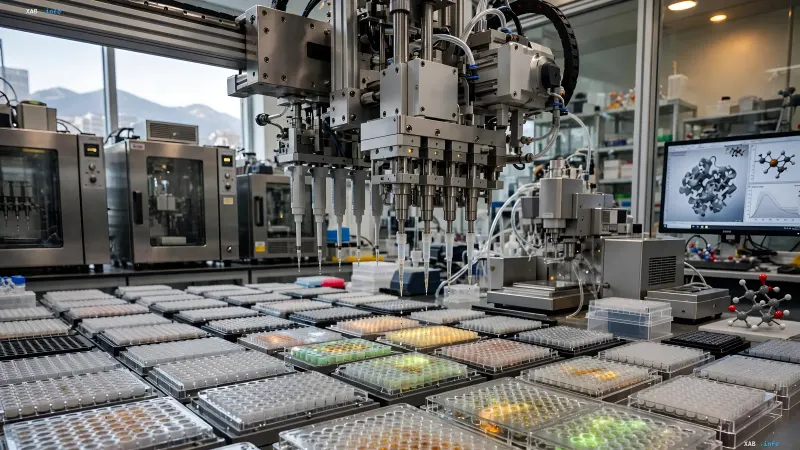
US startup Leash Biosciences has closed a new funding round of $11 million, earmarked for expanding its experimental infrastructure for training artificial intelligences on scientific experiments. The company is building automated laboratories that generate their own experimental database: according to Leash, over the course of its operations it has synthesized and tested 6.3 million of its own molecules and accumulated more than 44 billion experimental measurements across nearly 1,000 protein targets. It is precisely this mass of data that becomes the "training ground" on which AI agents learn not merely to analyze, but to independently drive the research process.
Why published data is not enough
The key problem Leash is solving is that modern drug-discovery models are predominantly trained on already-published scientific results. This approach allows a model to recognize patterns in known data, but it does not develop the ability to independently choose the next experiment, test hypotheses, and change strategy when results contradict the predictions. In a classical laboratory, a sequence of such iterations takes months or even years, making direct training on live experiments practically impossible. Leash proposes to work around this limitation by using automated experimental infrastructure that returns the results of physical experiments to the AI at high speed.
The Minos platform: virtual environments built on real measurements
To link the "hardware" with the model, the company has combined laboratory molecular screening with a software platform for evaluating and training AI. In October 2026, Leash unveiled Minos — a set of virtual research environments built on the results of real laboratory measurements. In the first six weeks of operation, AI agents carried out approximately 100,000 independent experiment sequences in these environments. The scale of such testing made it possible to identify systematic weaknesses in modern models: agents often chose unpromising experiments and did not always revise their strategy when new data contradicted their initial predictions.
Open data and plans for the raised funds
So that the community can study agent behavior and improve models, Leash has published a preliminary scientific paper, individual experimental environments, and thousands of reports on AI-agent actions. The $11 million raised will be directed toward expanding experiments beyond protein–molecule interactions, as well as developing partnerships with AI-model developers and pharmaceutical companies. In this way, the startup intends to train scientific models on how real experimental results confirm or refute the models' own decisions, forming a closed "hypothesis — experiment — revision" loop.
Significance for the drug-discovery industry
Leash's approach touches on one of the central challenges of biotechnology: moving AI from the role of a passive analyzer of the literature to that of an active experimenter. If automated laboratories enable agents to quickly receive feedback from physical experiments, this could significantly accelerate the cycle of molecule discovery and optimization. At the same time, the company is deliberately emphasizing transparency — publishing reports on agent actions and experimental environments gives external researchers the ability to independently assess where the models succeed and where they fail, which is important for trust in results that may ultimately be used in pharma.