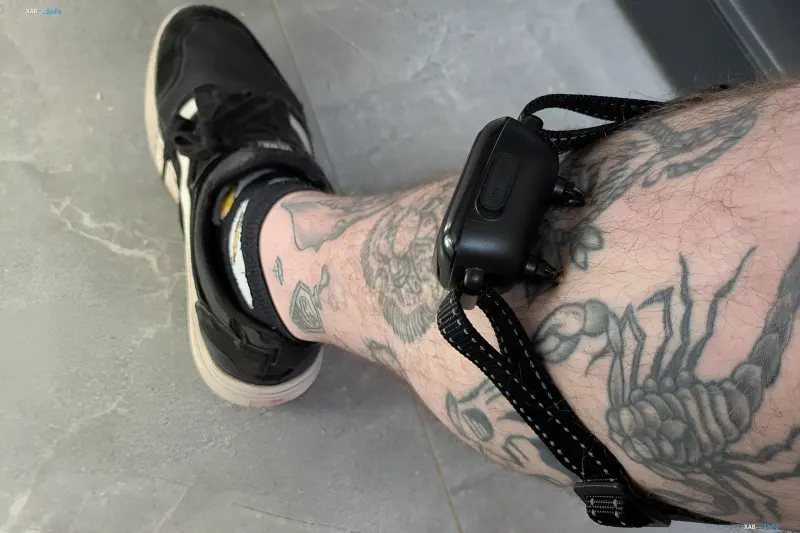
South African developer Liam Cloppers did something that borders on the absurd, yet it perfectly captures the central digital crisis of our time. Fed up with the fact that standard screen blockers and "digital hygiene" had stopped working, he took a Bluetooth training collar for large dogs, rewrote its API for a mobile operating system, and synced the device with his smartphone. The logic was extremely simple: every time Cloppers opened an app from his "blacklist" — X, Instagram, TikTok — and started mindlessly scrolling the feed, the collar automatically delivered a shock. In his own words, the experiment was launched at the moment he realized he was spending two to four hours a day doomscrolling, and no mental tricks were helping anymore.
First test: pain, fear, and a phone on the verge of falling
The result of the first experiment turned out to be radically stronger than the developer himself had expected. According to his account, even at minimum power the impulse triggered intense fear, and during the very first test Cloppers nearly hurled his smartphone against the wall. The physical pain and the suddenness of the shock worked as an instant "stop signal" for the brain: the familiar dopamine loop of "opened the app — got content — wanted more" was broken at the reflex level. However, it was precisely this effectiveness that became the problem: the method was so extreme that the developer started to be afraid of picking up the phone at all, not just during doomscrolling. In a situation where the smartphone is a work tool, such fear makes the method unsuitable for everyday use.
From electric shock to a beep: searching for a workable compromise
Acknowledging the shock therapy as "too extreme," Cloppers abandoned the electric shocks and replaced them with an irritating high-frequency beep. This sound does not traumatize the psyche or trigger a phobia of the device, yet it creates enough discomfort to kill the urge to scroll the feed mindlessly. From the standpoint of behavioral psychology, this is a classic method of negative reinforcement: instead of harsh punishment, an association is formed — "opened a forbidden app — an annoying sound appeared" — which gradually weakens the habit without psychological trauma. This approach is far more sustainable in the long run than physical pain, which, according to neurobiologists, does not eliminate the craving itself but merely replaces it with another stress.
Why it works: aversion therapy against dopamine loops
Cloppers's method relies on the concept of aversion therapy — forming an aversion to the habit's trigger. This approach was used in 20th-century psychiatry to treat various addictions, but it was later deemed inhumane and ineffective in the long term, which led to its removal from mainstream practice. Nevertheless, in the context of digital addiction, where the "punishment" is not a chemical drug but a user-controlled irritant, the logic of aversive conditioning gains new life. The key question here is one of scale: if a person has to resort to physical impact on their own body just to put the phone down, that is direct proof that modern social media algorithms are stronger than human will. Product designers at Meta, ByteDance, and X have spent years tuning dopamine loops — the infinite feed, likes, personalized pushes — so that they trigger biochemical habituation comparable to addiction. Against this multi-billion-dollar industry, ordinary mental effort no longer works, which is what gives rise to such radical DIY projects.
Contradictory data
Assessing the effectiveness and safety of Cloppers's method sparks disagreement even among those who describe the experiment. On the one hand, the developer himself confirms that replacing the electric shock with a high-frequency beep "effectively kills the urge to scroll the feed mindlessly," meaning the method worked as a behavioral barrier. On the other hand, he admits that the initial version with electric shock was "too extreme" and made him afraid of the smartphone itself, rendering it unsuitable for real digital work. Moreover, aversion therapy as a whole has historically been deemed inhumane and ineffective in the long term, which casts doubt on the sustainability even of the "softer" version of the method: the beep may stop being irritating over time, and the habit will return. Thus, we are dealing with a situation in which short-term behavioral effectiveness exists in direct contradiction to long-term psychological safety and the durability of the result.
The attention economy crisis: what's next
The story of the anti-social-media shock collar is not just a tech curiosity but a marker of a deep systemic failure in the "attention economy." When a user is forced to turn their own smartphone into a source of physical pain or irritation just to keep control over their attention, it means that digital product design has crossed a line beyond which human will is no longer a sufficient resource. Radical DIY solutions like Cloppers's collar are a symptom, not the disease: they show that individual "do-it-yourself" efforts can no longer compensate for what must be solved at the level of platform regulation, algorithmic transparency, and built-in digital hygiene tools. Until that happens, such experiments will keep reappearing — and, likely, in even more unexpected forms.