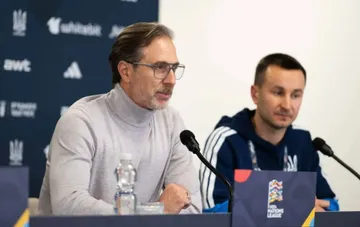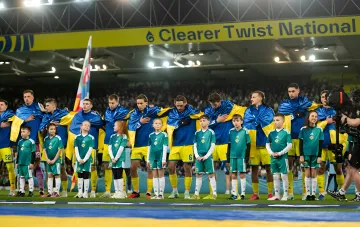
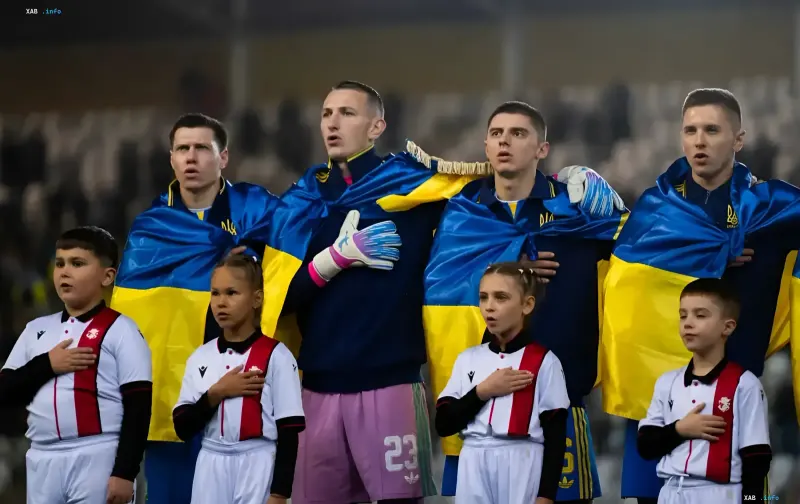
Sport RBC.UA commentator and columnist Kyrylo Krutorogov reviews Andrea Maldera's first full cycle as head coach of the Ukrainian national team in his latest column. Six matches in the 2026/27 Nations League, seven points, three goals scored, and a third-place finish in League B group — figures that, according to the author, demand a cold, sober look rather than applause. A victory over Georgia in Košice, secured by Danylo Sikan's first-minute goal, allowed the team to retain its spot in League B. However, the overall autumn outcome — two wins, one draw, and three losses with a 3:6 goal difference — falls far short of the maximum goal set before the start. Only Georgia, which failed to score a single goal in six rounds, remained behind Ukraine, while Northern Ireland topped the group with 12 points and Hungary followed with 11.
The Main Takeaway Is Psychological, Not Tactical
Krutorogov emphasizes that the key lesson of this cycle lies not in field formations, but in expectations. "We need to lower our expectations and curb our appetites," the author writes. According to him, the autumn of 2026 showed that the Ukraine national team is an utterly average side against the backdrop of Hungary, Northern Ireland, and Georgia: not a favorite that "underperformed," but a mid-tier team that twice lost to Northern Ireland and fell to Hungary at home. "We desperately want to believe we are closer to Belgium or Croatia than to Georgia. The standings say otherwise," the columnist states. In his view, until this is acknowledged, every subsequent cycle will follow the same script: high expectations at the start and frustration at the finish. Honest self-assessment, the author insists, is not capitulation, but a starting point for moving forward.
Club Form: Foreign League Status Doesn't Play by Itself
The hardest part, according to Krutorogov, is explaining the reasons for stagnation because formally everything looks fine: many national team players perform in Europe, including in strong championships. However, a closer look paints a different picture. Most of them lack a convincing season: some sit on the bench, some play episodically, and some dropped to the second division with their teams. A vivid example is Artem Dovbyk, called up to the national team after spending just 14 minutes on the pitch over the last six rounds of Serie A. Roman Yaremchuk found himself left out of Olympiacos's European squad, and only an injury to a competitor returned him to the lineup, though not to regular playing time. Add to this the injured Zinchenko, Malinovskyi, Tsygankov, and Zubkov, and it turns out that the team's recent main driving force is out of action. "We need new leaders, new key outfield players. And they are not yet visible," the author summarizes. The dilemma is simple: no confident club performance means no progress, and no progress means no positive impact on the national team, which you expect when reading club names in the call-up list.
Goalscoring: Three Goals in Six Matches and the Soil They Grow From
Most disappointing, according to Krutorogov, is the scoring record: just three goals in six matches, with two scored by Sikan and one by Yaremchuk. But to understand where goals can come from, one must look at the football soil from which the national team grows. In more than half of the UPL matches this season, fewer than three goals are scored, with an average scoring rate of about 2.37 goals per game. In the tenth round, four out of eight matches ended in 0:0 draws. A total of under 2.5 in the Ukrainian championship is not an exception, but the norm. "The national team cannot score more than its players score in their clubs. It merely reflects what is happening in the UPL and among Ukrainian legionnaires," the author writes. One can reproach Maldera for his team scoring little, but he is not the root of the problem.
The Northern Ireland Lesson: Catenaccio as a Working Tool
The most unexpected conclusion, in Krutorogov's view, lies within the group's statistics. Northern Ireland scored only six goals in six matches, three of which came against Ukraine in Trnava. In five other games, they scored no more than one goal per match. And that did not stop them from winning the group and advancing to League A. The secret is simple: one conceded goal throughout the entire tournament. A team that doesn't score heavily but doesn't concede wins games. Hungary, by the way, also scored only six. Across the entire group in 12 matches, there were only 15 goals. "Perhaps with an Italian coach who supposedly has catenaccio in his blood, we should finally forget that we are 'European Brazil' or 'Eastern European Spain'? Because that is not the case at all," the author asks. In his opinion, the national team should look for its true strengths: physical conditioning, defense, counter-attacks, resilience, and patience.
The Victory Over Georgia as a Model for the Future
Krutorogov draws attention to how the victory over Georgia actually looked: an early goal, an opponent holding possession with eight corners before halftime, while Ukraine relied on sharp counter-attacks and a reliable goalkeeper. "Maybe this is our true face? And tikitaka, dominance, and pro-attacking football are better left to those who..." the author trails off, leaving the reader to guess. The column's conclusion is unequivocal: a path upward exists, but the search for it continues, and for now, the team is far from finding the right one. Acknowledging this fact is the first step to ensuring the next cycle does not repeat the script of "high expectations and frustration at the finish."