Former contestant of the fifteenth season of the Ukrainian romantic reality show "The Bachelor," aerial gymnast Mariia Zakhvatova, shared details about behind-the-scenes life in a candid interview. She discussed how payments, meals, and daily life were organized in the house where about fifteen girls and a significant crew lived simultaneously. Zakhvatova noted that overall living conditions did not seem excessively difficult, but certain circumstances caused additional discomfort, primarily due to the inability to communicate with loved ones daily.
Per Diems and Confidentiality Issues
One of the most discussed aspects of working on a reality show is the financial remuneration for female contestants. Mariia Zakhvatova confirmed that the project organizers provided the girls with per diems, though she did not disclose the exact amount. "I don't know if I'm allowed to say this, but they gave us rather modest per diems," the gymnast shared, emphasizing that she was unsure whether she had the right to disclose financial contract details. Thus, the exact amount of the participants' fees remains open, and the phrasing suggests that the payments were likely not the main motivation for participating in the project.
Meals Under a Tight Shooting Schedule
One of the most tangible inconveniences pointed out by Zakhvatova was the inability to eat properly due to the intensive shooting schedule. The girls did not always have time to eat and drink normally between scenes. Participants bought groceries independently: every few days they were taken to a supermarket, and an additional opportunity to buy food arose during dates. During breaks between shoots, they sometimes had to cook something quick. Zakhvatova recalled how Khrystyna Horniak boiled dumplings for everyone—the girls had a quick snack and returned to work in front of the cameras. According to Zakhvatova herself, the organizers should have arranged for the delivery of groceries or prepared food, as walking to the store independently under such a tight schedule was inconvenient and time-consuming.
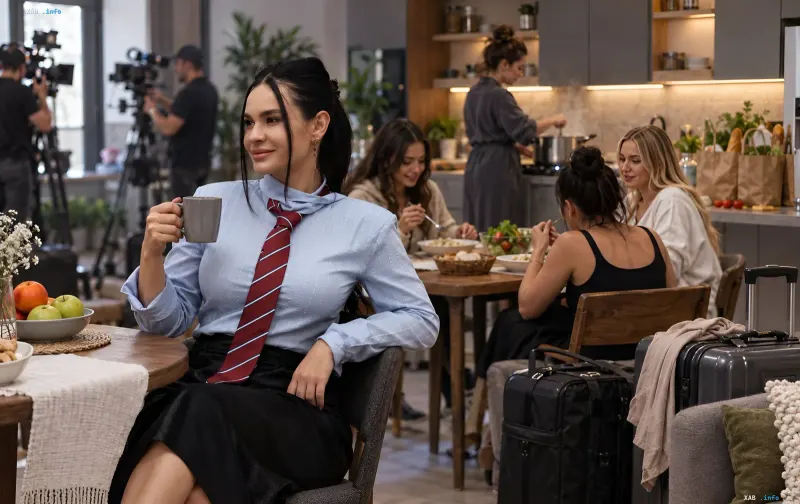
Despite about fifteen participants and numerous crew members being in the house simultaneously, serious conflicts over cleaning, according to Mariia, did not arise. Each girl was responsible for cleaning up after herself: "Everyone cleaned up after themselves, there were no arguments because of that." At the same time, participants actually had no time to fully set up their personal space. They lived out of suitcases and didn't even unpack all their belongings since most of the time was taken up by filming and preparation. Behind-the-scenes footage shows participants gathering around a common table during breaks while camera operators with professional equipment on tripods work in the background—clearly demonstrating the scale and intensity of the production process.
Cleaning, Personal Space, and Living Out of Suitcases
For comparison, it is worth noting that the hero of the previous season, actor Taras Tsymbaliuk, spoke about the financial side of his participation in an interview for the Okay Eva podcast. According to him, he did not view the show as a way to earn money, but he did not want to spend time and effort on unpaid filming. At the stage of negotiations with producers, Tsymbaliuk suggested tying his fee to the number of filming days and setting payment at the level of his usual rate for feature films. The actor also explained that participating in the project had another purpose for him—to attract a new audience and boost his own recognition. After the reality show ended, Tsymbaliuk reviewed and increased his professional rates, though he did not name the exact fee for "The Bachelor."
Financial Model for the Lead: Taras Tsymbaliuk's Experience
Revealing household details of working in a romantic reality show is important for understanding the real production model of such shows. While the male lead participates under an individual contract tied to a professional rate, the female contestants, according to Zakhvatova, receive per diems and handle some household chores themselves. This creates an asymmetry in working conditions between the two categories of participants. At the same time, neither Zakhvatova nor Tsymbaliuk named specific amounts, indicating the widespread reality TV industry practice of financial confidentiality. Nevertheless, the general conclusion from both interviews is unambiguous: participating in "The Bachelor" is full-time work with a tight schedule, not just the "pretty picture" the viewer sees on screen.