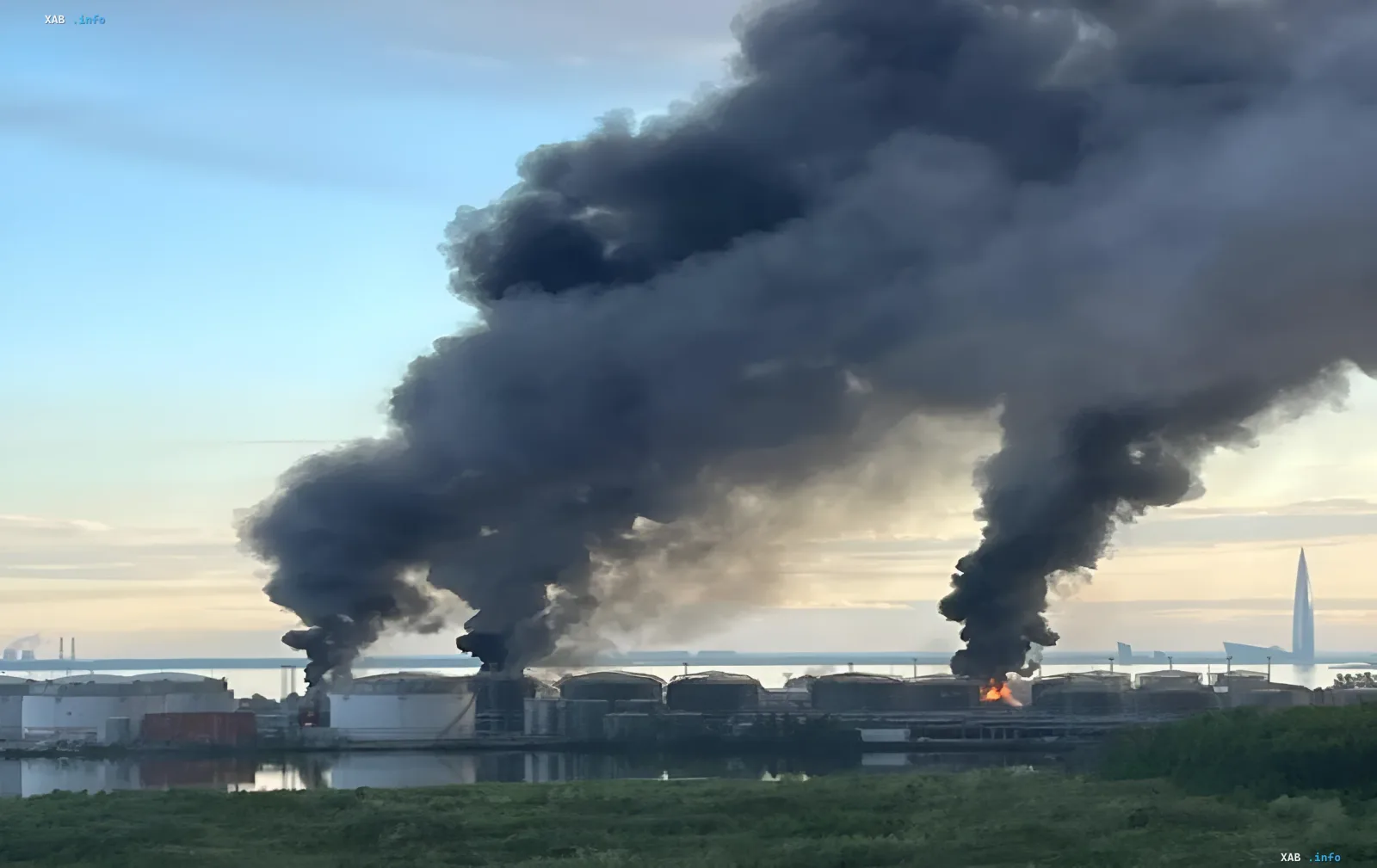
On the night of June 3, a large-scale drone attack occurred at the St. Petersburg port. As a result of the strikes, an oil terminal, one of the key objects of the oil refining infrastructure in Northwestern Russia, caught fire. The fire engulfed oil storage tanks, and explosions continued until morning, accompanied by thick columns of black smoke that were visible for many kilometers.
Timeline of Events: From Warning to Fire
The attack began after an official warning about the drone threat. Powerful explosions followed in the port, which were captured on video published on social media. The footage clearly shows blasts and active burning, which quickly escalated into a major emergency. Fire services and emergency services were put on high alert.
By morning, the situation had not stabilized — explosions continued, and the fire spread even further. Alexander Dрозденко, the Governor of the Leningrad Region, reported in his Telegram channel that 30 drones had been shot down over the region. However, he did not mention the fire in the port in his message, which raised additional questions among the public.
St. Petersburg Oil Terminal: A Strategic Object
The damaged facility — PJSC "St. Petersburg Oil Terminal" — is the largest oil refining complex in Northwestern Russia. Its 37-hectare territory houses 21 storage tanks for light and dark petroleum products. The terminal's throughput capacity is 12.5 million tons per year.
The enterprise is recognized as strategically important for ensuring the security of the Russian Federation and has been included in the register of natural monopoly subjects since 2000. According to "SPARK-Interfax," the terminal's revenue in 2024 amounted to 8.6 billion rubles, with a profit of 5.8 billion rubles. In 2020, 8.2 million tons of petroleum products were shipped.
Context: Mass Attacks Across Russia
The attack on the St. Petersburg port was not an isolated incident. On the same night, drones also attacked Moscow. The capital's mayor, Sergei Sobyanin, repeatedly reported on shot-down drones and the work of services at the sites where debris fell.
Simultaneously, on the night of June 3, drones struck the "Progress" defense industry plant in the Tambov region. These events became part of a massive drone attack on Russian cities, which followed missile strikes on Ukraine — specifically, on Kyiv, Kharkiv, and Dnipro.
As a result of the strikes on Ukrainian cities, dozens of people were killed, more than a hundred were injured, including children. These events highlight the escalation of the conflict and its impact on the civilian population on both sides.
PIEF and Economic Consequences
It is worth noting that from June 3 to 6, the St. Petersburg International Economic Forum (PIEF) was scheduled to take place in St. Petersburg. The attack on the oil terminal, located near the city, could affect the conduct of the event and the perception of security in the region.
If the fire in the port is not contained quickly, it could lead to disruptions in the supply of petroleum products, affecting not only the local economy but also logistics chains across the country. There are also possible environmental consequences due to smoke emissions and potential contamination of water resources.
The situation is developing, and there is currently no official data on the full scale of the damage. However, it is already clear that the attack on the oil terminal in the St. Petersburg port has become one of the most significant incidents within the framework of the current escalation of the conflict.


