Despite its technological scale, modern civilization risks leaving behind fewer material traces than ancient peoples. While Egyptian pyramids and Sumerian cuneiform tablets have stood for millennia, digital storage media are vulnerable and short-lived. To counter this, the international project Memory of Mankind (MOM) is launching the creation of a unique analog archive to be hidden two kilometers underground.
The Threat of Digital Oblivion
The project's initiator, Austrian engineer Martin Kunz, warns: in the long term, the only traces of our era may be global warming, radioactive waste, and energy drink cans. The digital repositories we rely on today are extremely unstable. According to NASA, a powerful coronal mass ejection could destroy servers and cloud storage, erasing scientific works and cultural heritage.
The problem is exacerbated by the rapid obsolescence of formats. Floppy disks, video cassettes, and MiniDiscs became useless junk within just a few decades due to the disappearance of reading devices. Paper media is also not eternal: under unfavorable conditions, paper turns to dust, and a wet newspaper decomposes within six weeks.
The Technology of Eternity
To solve the durability problem, the MOM team has joined forces with scientists and universities to create a repository in the Hallstatt region of the Alps. The archive will be based on plates made of high-tech ceramics measuring 20x20 cm. This is one of the most durable materials on the planet, capable of withstanding temperatures up to 1300°C, as well as exposure to acids and alkalis.
Data on the plates is recorded in two ways:
- Color printing: ceramic pigments with 300 dpi resolution for photos and diagrams, protected by a transparent glaze.
- Ceramic microfilm: black-and-white laser recording. Text is reduced to five lines per millimeter but is easily readable with a standard 10x magnifying glass.
One such plate holds up to 5 million characters — equivalent to a 400-page book, but takes up 200 times less space.
Natural Protection and Access Conditions
The archive will be located in a salt mine. Salt has unique properties: it is plastic and gradually fills voids at a rate of 2 cm per year, naturally sealing cracks and isolating capsules from water and humans. The pressure of the mountain will protect the containers even in the event of a new ice age with ice thickness up to 5 km.
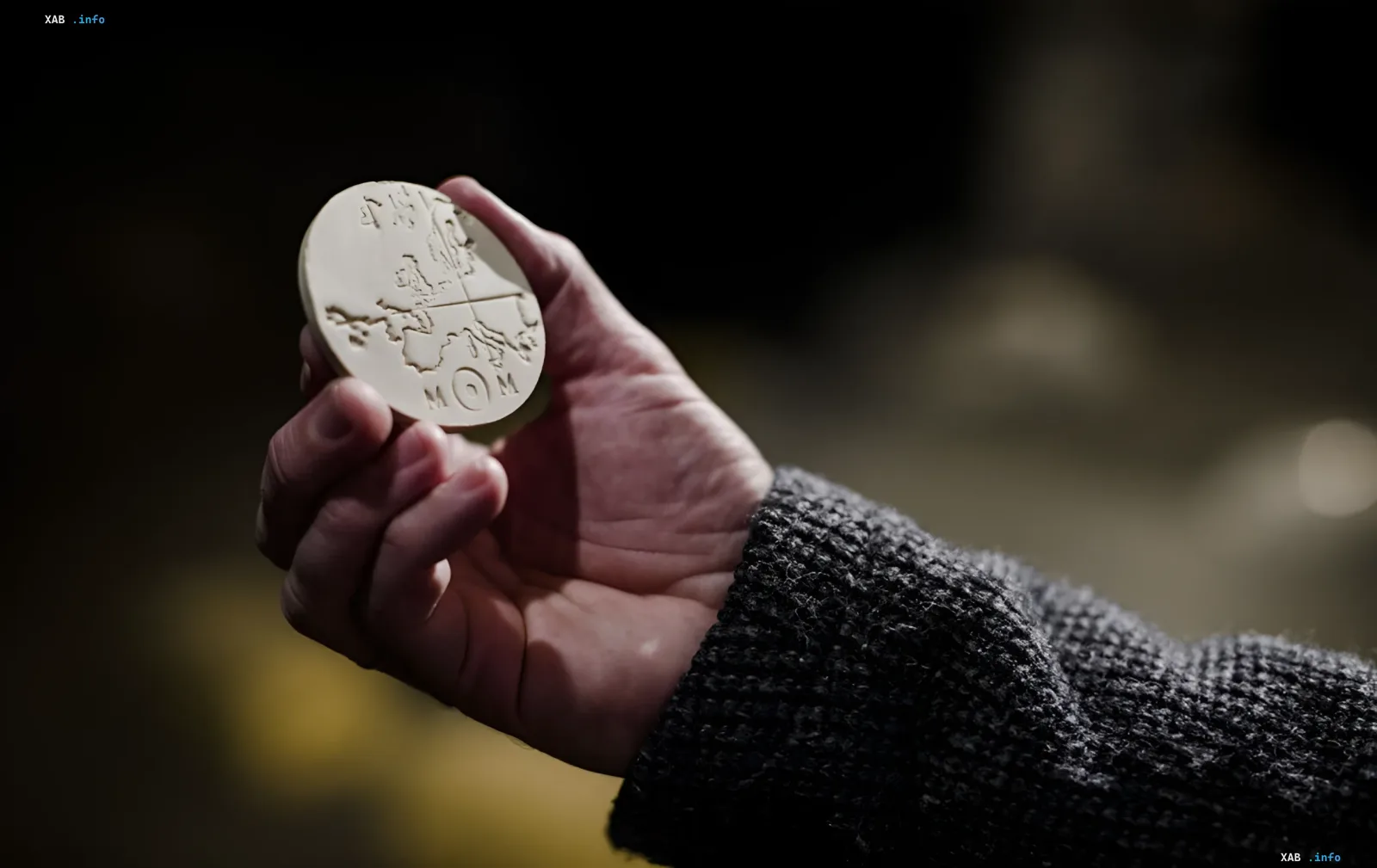
To help find the archive in the future, developers created a system of round ceramic tokens — "treasure maps." They are distributed among project participants worldwide. The token is hardened at 1200°C and serves as both a map and a chronometer. To decipher the map, a future civilization must possess a certain level of knowledge, which excludes accidental discovery by primitive tribes.
What's Inside the Archive?
The project does not aim to create a complete copy of Wikipedia, as knowledge is constantly changing. The goal of MOM is to capture a snapshot of our era. The archive includes:
- Automatically collected data: daily articles from leading newspapers around the world to avoid bias.
- Institutional selection: scientific works, Vienna dissertations, descriptions of inventions, and, critically important, maps of nuclear and toxic waste repositories to warn descendants.
- Individual stories: crowdsourced texts from ordinary people — diaries, love stories, recipes, and photos.
Curators note that descriptions of events in different languages will be invaluable material for future linguists. To assist in deciphering, a special version of the Rosetta Stone has been created — a visual dictionary with thousands of images of objects and actions.
Who is the Message Addressed To?
Martin Kunz admits that the recipients of the message may not be humans, but a new intelligent species (for example, descendants of raccoons) or even extraterrestrial civilizations. MOM collaborates with initiatives placing similar markers at Lagrange points in the Solar System. Evolutionary analysis shows that to understand the archive, a civilization must possess the ability for abstract thinking and live on a planet with continents that allow for mining metals and creating ceramics.


