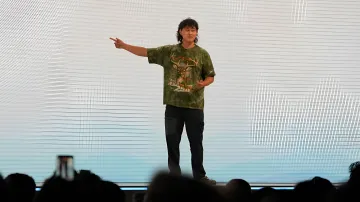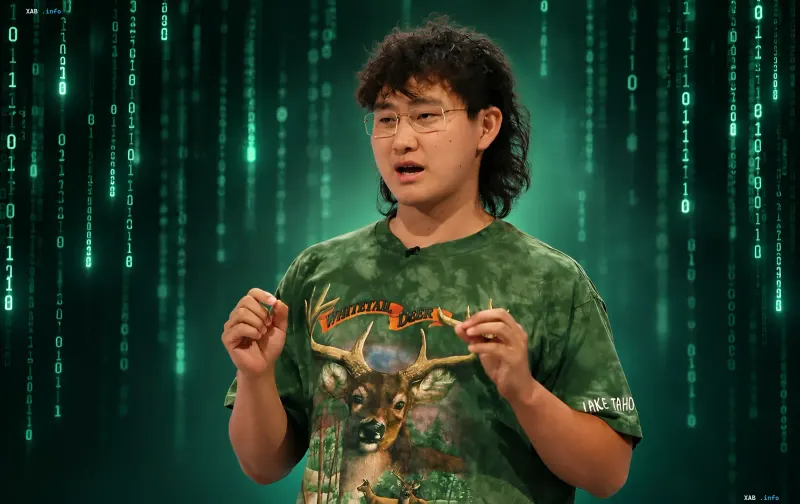
Alexander Wang, head of Meta Superintelligence Labs, has published an extensive post on X arguing that artificial intelligence is on the verge of transitioning to self-improvement and could eventually surpass humans by a thousandfold. According to his assessment, the coming year will be decisive in ensuring humanity retains control over developing systems. This was reported by RBC-Ukraine, citing Wang's publication.
The Riemann Hypothesis proof as a turning point
Wang links the beginning of large-scale changes in science to the potential proof of the Riemann Hypothesis—a mathematical problem researchers have been working on for about 150 years. He compares the difficulty of the task to "tasks significantly exceeding in intellectual level even the creation of the atomic bomb." According to him, an "alien intelligence" has already joined in solving it, the capabilities of which humans are not yet able to fully grasp.
From competition problems to independent research
The first signs of a breakthrough, according to Wang, appeared back in December 2024, when o3-series models began successfully solving AIME math competition problems. Although teenagers participate in the competition, its tasks, he says, require a higher level of thinking than most daily tasks for engineers, cybersecurity specialists, and businesses. Over the last two years, he claims, models have made significant progress in programming, cybersecurity, and executing complex tasks independently, while previous practical limitations—a lack of knowledge, insufficient context, and infrastructure barriers—have gradually been eliminated.
What is slowing progress now
Wang believes that research conducted by AI itself is intellectually simpler than proving the Riemann Hypothesis, so modern models already possess sufficient capabilities to automate parts of their own research and improve without constant human involvement. In his opinion, this could sharply accelerate progress not only in AI but also in biology, economics, and defense technology. He identifies the main obstacles now not as the models' intellectual capabilities, but as a lack of specialized knowledge, workflow optimization, and the need to conduct real-world experiments.
Control and the criticism of "lazy thinking"
The head of Meta Superintelligence Labs warns that maintaining control over systems capable of continuous improvement will be extremely difficult. Since he considers scientific and technical barriers almost overcome, issues of AI safety, aligning its goals with human ones, and protection against misuse come to the forefront. Wang separately criticizes an approach prevalent in the industry, which he calls "lazy thinking": when the emergence of superintelligence is declared inevitable, and discussion is reduced only to how to make it safe. He is convinced that society should not passively agree to transfer control over the future to AI, and the industry should create technologies that expand human rights, capabilities, and freedom.