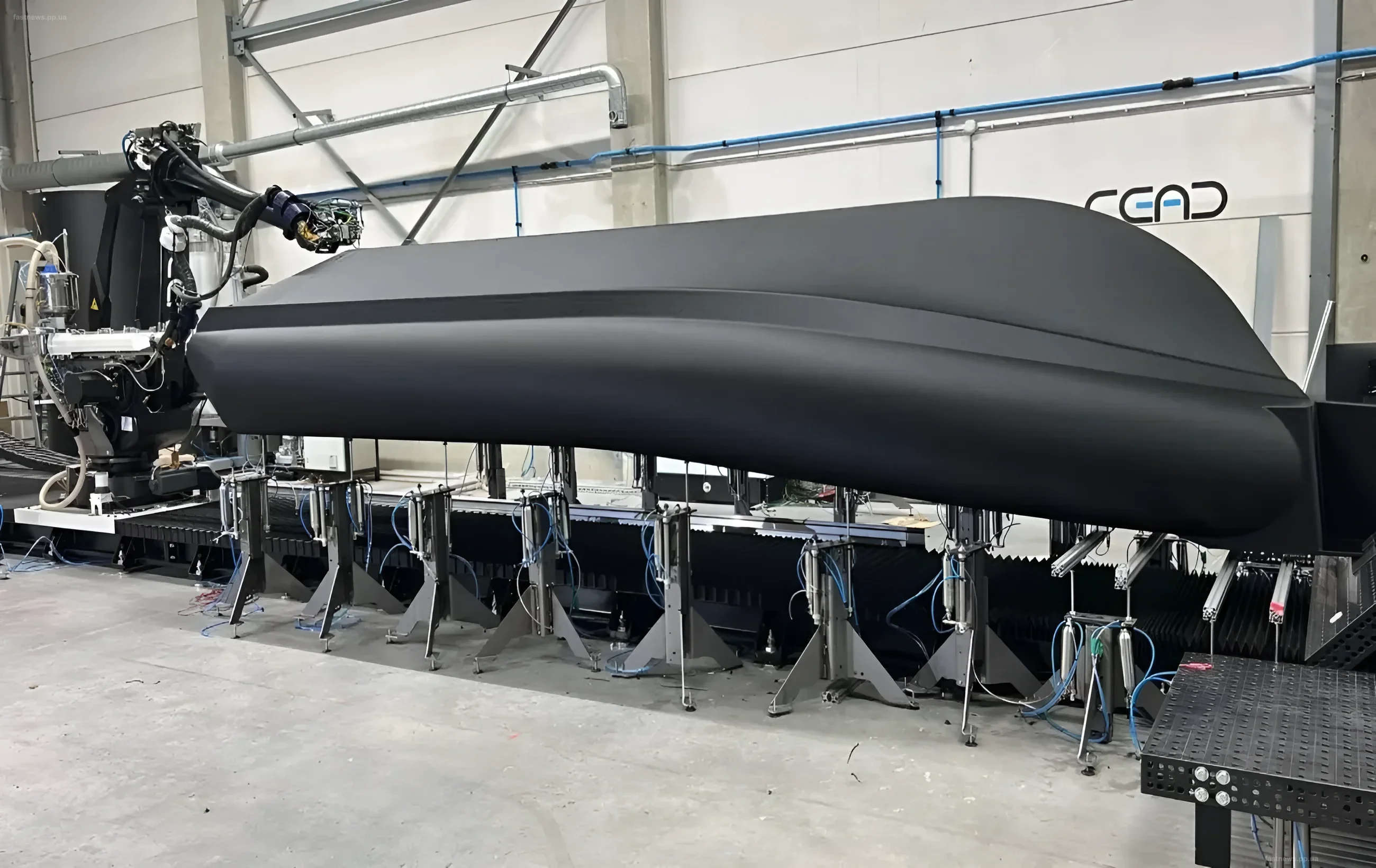
The era of long lead times and complex assembly lines is fading into the past. A true revolution is taking place in the world of military shipbuilding, driven by additive manufacturing. American startup Voltage Vessels from Hawaii has unveiled a technology capable of radically changing fleet logistics: combat boats can now be printed directly in conflict zones.
Traditional construction of Rigid-Hulled Inflatable Boats (RHIB), the standard for Navy SEALs and the Coast Guard, is a labor-intensive and slow process. It requires massive shipyards, complex molds, and months of work. Voltage Vessels proposed a radically different path: one powerful industrial 3D printer and a digital file replace an entire shipyard.
At the heart of the innovation is a unique composite material called Eclipse X9. This is not just plastic, but a complex engineering blend of recycled thermoplastic and crushed basalt—a durable volcanic mineral. This composition allowed for the printing of a 6-meter combat boat that outperforms traditional counterparts in its characteristics.
Technological Breakthrough: The Strength of Stone and Plastic
Scientists from the University of Maine, one of the leading centers for 3D printing research, conducted a series of rigorous tests. The results exceeded expectations: the tensile and flexural strength of Eclipse X9 is twice that of materials used for civilian vessels. However, the main advantage lies not only in strength.
Thanks to the basalt base, the boat's hull possesses unique radar-stealth properties. Unlike metal, this composite does not reflect radar waves, making the boat practically invisible to enemy detection systems. Furthermore, the material does not interfere with its own electronics, radios, and navigation sensors, which is critical for tactical operations.
Operational durability is also top-notch. After more than two years of testing in aggressive salty seawater, the material showed minimal water absorption (less than 0.4%) and retained over 90% of its original strength.
New War Logistics and Ecology
The strategic goal of Voltage Vessels is to move away from centralized shipyards. Instead, the US military plans to deploy a network of mobile printing hubs at bases around the world—from Guam to Japan. This will allow for the rapid replenishment of lost equipment or the creation of new vessels exactly where they are needed.
The technology also addresses the issue of disposal. The plastic hull can be recycled an infinite number of times. If a boat sustains critical damage or reaches the end of its service life, it can be shredded, melted down, and used as raw material for printing new parts or an entire vessel. This creates a closed-loop production cycle that saves resources and reduces the environmental footprint.
Currently, the first prototype has been handed over to the military for full-scale army trials. Future plans include integrating these boats into autonomous marine robot programs, paving the way for fully printed fleets of the future.


