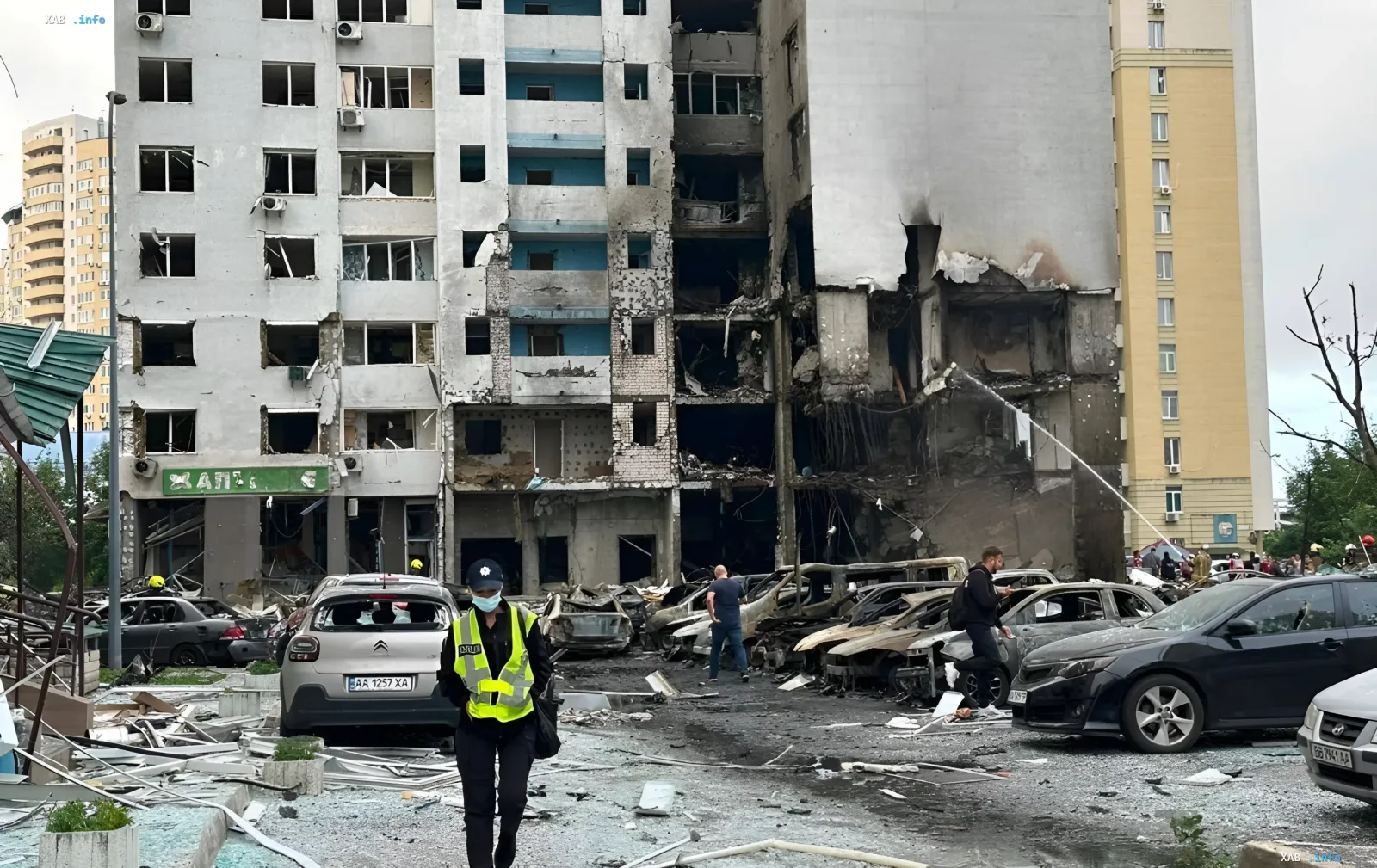
Contrast between statements and reality
The night attack on Kyiv on July 6 divided official rhetoric from the grim reality on the ground. The Russian Ministry of Defense stated that strikes were carried out exclusively against military infrastructure. According to the ministry, fuel depots, airfields, and factories producing drones and Neptune missiles in the Dnipropetrovsk, Poltava, Cherkasy, Chernihiv, and Kyiv regions were hit. The Russian military press release made no mention of residential districts.
However, the actual picture of events in the Ukrainian capital looks different. Missiles hit at least two residential buildings. Destruction covered about 30 high-rise buildings, turning parts of the city into ruins. At least 14 people were killed in the attack, and about 60 more were injured.
The most affected areas
The Pechersk and Darnytskyi districts of Kyiv suffered the most damage. The situation in the Vyshneve settlement remains critical: due to the threat of secondary explosions, evacuation of residents continues. Ukraine's air defense forces failed to shoot down a single ballistic missile during this attack. Experts link this to a shortage of interceptor missiles for Patriot systems.
Political resonance and demands on NATO
Ukrainian President Volodymyr Zelenskyy commented sharply on the situation. He stated that Russia continues to destroy civilian objects with impunity while missiles for air defense systems remain in the stockpiles of allies. The head of state is demanding that the NATO summit in Ankara make concrete decisions capable of truly protecting the Ukrainian sky.
An analysis of air defense effectiveness showed that all ballistic and hypersonic Zircon missiles broke through the defense, while the interception rate for cruise missiles was nearly 100%.


