
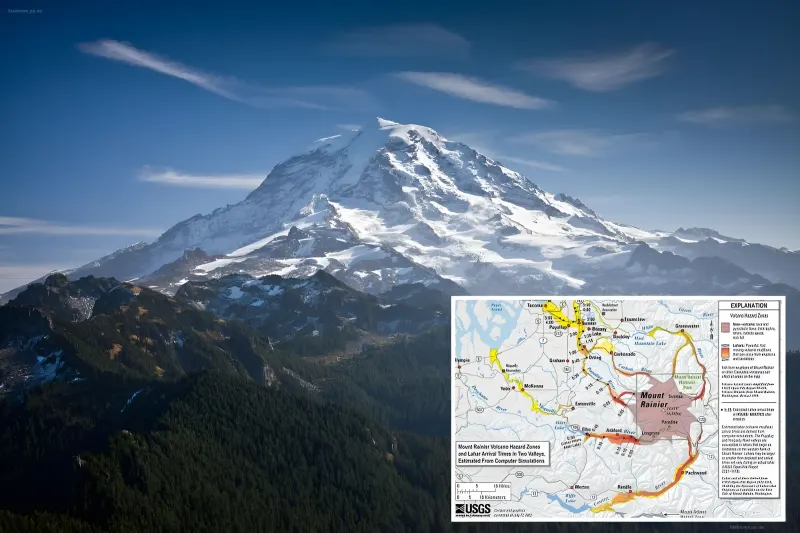
The massive snow cap of Mount Rainier in Washington State is not just a picturesque backdrop for postcards but a potential mechanism for catastrophe. Scientists warn: this peak, considered the most dangerous in the USA, is capable of destroying three major cities in a matter of minutes. And the scariest part is that you don't necessarily have to wait for a volcanic eruption for this to happen.
The Threat Hidden in the Ice
Rainier rises to 4,300 meters and dominates the Cascade Range landscape. Its danger lies not only in seismic activity or magma but also in the colossal volume of ice. The volcano's slopes host 25 major glaciers containing five times more snow and ice than all other regional volcanoes combined. This creates ideal conditions for the formation of mudflows known as lahars.
What is a Lahar and Why is it Lethal
A torrent of mud, rocks, and glacial water that sweeps everything in its path moves at speeds exceeding 160 km/h. These flows can reach hundreds of feet in height and travel distances up to 80 kilometers from the source. According to volcanologist Lizette Caballero Garcia from the National Autonomous University of Mexico, lahars are complex phenomena that can change their volume and composition as they move, becoming alternately denser or more diluted.
Catastrophe can happen instantly. A small amount of ice melting, caused by rain or an earthquake, is enough to trigger a process that cannot be stopped. Andy Lockhart, a former geophysicist at the Cascades Volcano Observatory, describes such events as "what scares you at night," emphasizing that they can occur without warning.
Targets on the Map: Orting, Puyallup, and Sumner
Calculated paths of Rainier's flows pass through Pierce County, where approximately 150,000 people live. The cities of Orting, Puyallup, and Sumner are in the direct danger zone. If a lahar breaks its banks, it will reach these settlements in just 30 minutes, threatening the lives of approximately 60,000 residents. The tragedy of 1985 in Colombia, when the eruption of Nevado del Ruiz claimed the lives of more than 23,000 people in the town of Armero, serves as a grim reminder of the power of these natural disasters.
Preparing for the Worst
Recognizing the scale of the threat, authorities are not sitting idly by. The Cascades Volcano Observatory has deployed a network of sensors monitoring seismic activity and avalanche movement to transmit data to rescuers in real-time. Additionally, large-scale drills are conducted regularly. Two years ago, more than 45,000 students and school staff in cities west of Rainier participated in them. Simulations confirmed that in the event of sudden flooding, the only effective way to save lives is to run on foot to higher ground.


