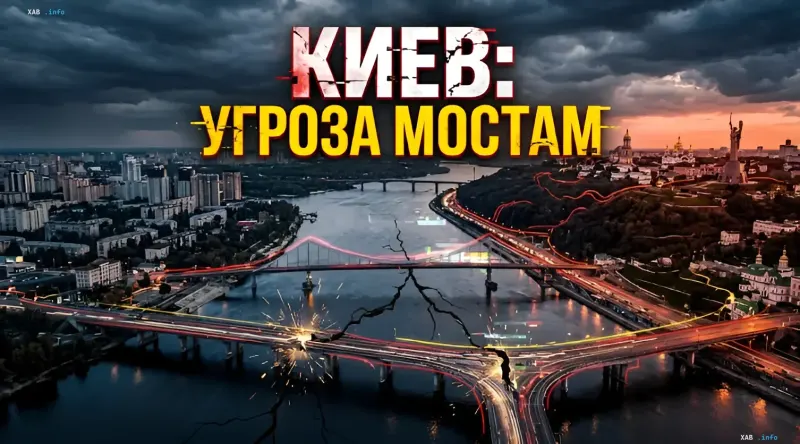
People's Deputy of Ukraine and Deputy Chairman of the Verkhovna Rada Committee on Transport and Infrastructure, Volodymyr Kreidenko, has issued a statement regarding the potential vulnerability of bridge crossings over the Dnieper in Kyiv. According to him, in the event of targeted strikes on several key crossings, transport connections between the Right and Left Banks could be completely severed, effectively isolating the capital into two separate areas. The deputy also noted that at a city-wide level, according to his assessment, there is no systematic alternative scenario for ensuring logistics, evacuation, and emergency delivery of cargo and medical aid.
Essence of the statement and context
Kreidenko emphasized that the Dnieper historically divides Kyiv into two functional parts: the administrative-business hub on the right bank and the residential cluster on the left bank. Hundreds of thousands of residents travel between the banks daily via a limited number of crossings. Disabling even two or three key bridges, the deputy said, would instantly overload the remaining ones, and in the event of a massive attack, traffic between the banks could be blocked. He explicitly indicated that there is currently no ready-made systematic plan of action for such a scenario, according to his assessment.
Dnieper crossing infrastructure
Kyiv has several main bridge crossings: the Northern Automobile Bridge, the Metro Bridge (road and metro), the Paton Bridge (the oldest all-welded bridge, with restrictions for heavy transport), the Darnytskyi combined rail-road crossing, the Southern cable-stayed bridge with limited civilian traffic, and the Podilsko-Voskresenskyi crossing with partial restrictions. The daily traffic flow across the Dnieper in Kyiv, according to data provided by the deputy, is about 300,000–350,000 vehicles, in addition to metro line passenger flows (Sviatoshynsko-Brovarska and Syretsko-Pecherska lines).
Limitations of pontoon crossings
As a temporary measure for installing pontoon crossings, tentatively by the end of winter, municipal services and military engineers are considering them as compensation for a possible severance. However, according to experts, floating structures cannot replace permanent bridges. A permanent crossing provides 6–8 lanes and a capacity of up to 80,000–100,000 vehicles per day, while a pontoon crossing offers at most one or two reversible lanes with a speed of 15–20 km/h and strict tonnage limits. Furthermore, the end of winter and the beginning of spring on the Dnieper is a period of ice drift and water level fluctuations due to discharges from the Kyiv Hydroelectric Power Plant, which increases risks for floating structures. A pontoon crossing is also an exposed object requiring constant cover by air defense and electronic warfare systems.
Possible consequences of severing ties
In the event of a prolonged disruption of communication between the banks, according to the deputy, problems with life-support supply chains would arise: delivery of food, fuel, medicines, and cargo from right-bank logistics hubs to the Left Bank would require multi-kilometer detour routes through other regions. The medical sector would also be affected, as a number of specialized clinics are concentrated mainly on the Right Bank, and the redistribution of energy and utility capacities in the event of damage to utility collectors laid along bridge structures would become a complex engineering task.
Recommended preventive measures
The expert community and the parliamentary committee insist on several steps: developing a public logistics protocol zoning medical, food, and rescue services by bank and forming autonomous stocks on the Left Bank for 60–90 days; preparing alternative water transport (barge ferries and river trams) for the spring-summer period; and including bridge crossings and adjacent interchanges in the first-priority critical infrastructure category to strengthen the local air defense dome. The committee's statement has been sent to the Kyiv City State Administration and the Cabinet of Ministers as a signal of the need to develop a crisis plan. It is noted that a number of bridges, in particular the Paton Bridge and the Metro Bridge, required major repairs even before the start of full-scale hostilities.