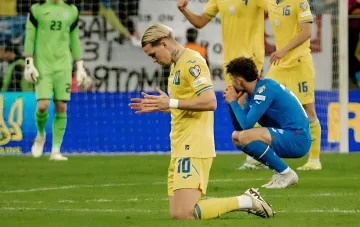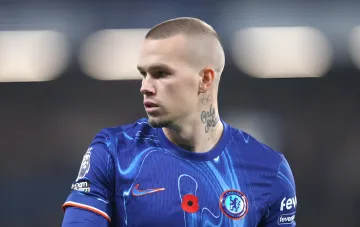

In a recent interview with journalist Dmytro Gordon, Ukrainian midfielder Mykhailo Mudryk, who plays for London's Tottenham, spoke in detail for the first time about how his agency representation had been structured for over ten years. According to the footballer, he practically did not have a full-fledged agent — his interests were represented by people he unconditionally trusted since his youth. Mudryk also revealed details of financial problems that arose after his transfer to Chelsea, and mentioned lawsuits and phone threats he faced in England. This was reported by Sport RBC.UA citing the recording of the conversation.
"A front man with a license"
The central element of Mudryk's story was the figure of Yevhen Krasnikov, whom the footballer called his "football father" and the person who actually managed his entire career. Mudryk emphasized that calling Oleksiy Alyokhin his agent is "very difficult" and "even harder." According to him, Alyokhin was not present at the signing of the contract with Chelsea and, essentially, was "a front man who has an agency license" but who "decides nothing." "Behind all this stands Yevhen Krasnikov, who called me his son and who helped me for 10 years. And every day he hammered into my head from the age of 13 that 'I am everything to you and will never take a penny from you,'" Mudryk stated. The footballer stressed that agents "at least should be present at the signing of some important documents," which did not happen in his case.
"What, don't you trust us?"
A separate block of the interview is dedicated to how Mudryk signed contracts. By his own admission, he did so "never reading them." The reason for this approach, according to the footballer, was the reaction of his inner circle to his single attempt to read the terms of a document. "Because once I tried to read it, and Alyokhin and his assistants told me: 'What, don't you trust us?'. And I signed without reading. I trusted people," Mudryk shared. Thus, the footballer actually confirmed that key financial and legal decisions were made without his conscious participation, based on personal trust in the people who accompanied him since the age of 13.
Tax on someone else's bonus
After moving to Chelsea, Mudryk faced unexpected financial obligations. According to him, he had to pay tax on a bonus that the agents received — the footballer did not know about the existence of this bonus in advance. "Instead of earning and saving for something, I had to pay tax on a bonus that the agents received and that I didn't know about at all. I asked once, but I was told: 'Don't worry, if anything, we'll pay you back.' In the end, I still owed money," Mudryk said. He emphasized that instead of concentrating on football, he was forced to deal with lawsuits.
Ultimatums and threats
In addition to financial claims and legal proceedings, Mudryk reported phone calls from individuals he characterized as "bandits." According to him, these calls were accompanied by threats and ultimatums. "Besides the fact that you still owe money and some lawsuits are filed against you, bandits call you on the phone, threaten you, and issue ultimatums," the footballer summarized. Specific details of these calls, as well as names or organizations behind them, were not disclosed in the interview.
Doping scandal: who is to blame
At the end of the conversation, Mudryk touched upon the topic of his doping scandal, pointing to those he considers responsible for what happened. However, in the available part of the interview, specific details and names in this context were not disclosed. The very fact that the footballer links the doping incident to the actions of his inner circle adds another layer to the overall picture of systemic distrust, which, according to him, was replaced by unconditional faith in the people who accompanied his career since adolescence.