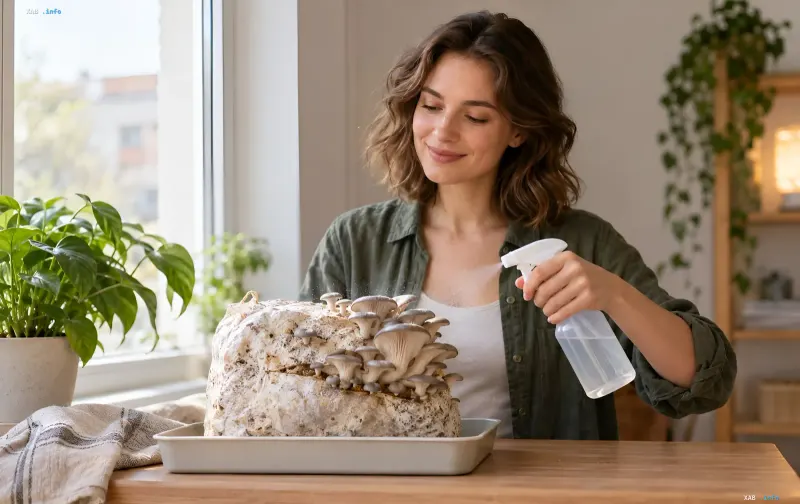
To grow edible mushrooms at home, you do not need to set up a separate room or buy expensive equipment. The most accessible option for beginners is a ready-made mushroom block, which requires only proper care. According to University of Vermont Extension, oyster mushrooms are one of the best choices for a first experience: they grow quickly, easily adapt to various indoor conditions, and do not require complex inventory. In this article, we examine which types are suitable for beginners, how to get a harvest in two ways, and how long it takes.
Which mushrooms to choose for a first experience
For your first attempt, it is most convenient to settle on a ready-made kit with oyster mushroom mycelium. Shiitake and lion's mane can take noticeably longer to mature, making them less convenient for getting acquainted with the process. Oyster mushrooms, on the other hand, stand out for their growth speed and undemanding nature, making them an optimal choice for those just starting with home mushroom cultivation.
Soil is not needed: What is a substrate and a mushroom block
Unlike houseplants, mushrooms do not need regular soil. They get nutrients from a substrate—the organic material on which the mycelium develops. As the North American Mycological Association explains, depending on the species, the substrate can be straw, sawdust, wood chips, or logs. A ready-made block already contains the substrate colonized by mycelium, so there is no need to independently prepare a nutrient medium and add mycelium.
Two ways to get a harvest
The first and easiest path is a ready-made mushroom block. Such kits allow you to grow mushrooms year-round, and under favorable conditions, the first harvest of certain species can be obtained in just two to three weeks. After the primordia of the fruit bodies appear, the mushrooms usually develop quite quickly, and you only need to maintain the necessary humidity until they reach the size recommended for harvesting. The exact maturation period depends on the species, temperature, and care conditions.
If you want to try growing without a ready-made block, you can use a plastic bucket, wood chips, and purchased mycelium—a method described by University of Wisconsin Extension specialists. It requires more preparation but allows you to independently create an environment for the mycelium to develop. At the same time, the first small mushrooms may appear later if the mycelium develops more slowly, so you should not dismantle the bucket just because there is no harvest after two weeks.
When and how to harvest oyster mushrooms
According to the recommendations of the Royal Botanic Gardens, Kew, oyster mushrooms can be harvested when their caps begin to flatten and become flatter. An additional sign of readiness is a slight darkening of the cap edges. At the same time, you should not wait until the edges darken heavily and the mushrooms start to dry out. Ready oyster mushrooms are cut at the base with a clean knife or carefully separated in a twisting motion. Harvesting should not be delayed for long: overripe mushrooms lose their desired texture and can actively release spores.
Re-fruiting and condition control
After the first harvest, the mycelium is sometimes able to fruit again. To do this, you need to continue caring for the substrate according to the manufacturer's instructions, while subsequent harvests may be smaller than the first. Texas A&M AgriLife Extension specialists emphasize that for successful cultivation, it is important to control several basic conditions, and failures are most often associated precisely with improper care.
Signs of contamination and safety
A healthy mycelium is usually white in color. If unusual color spots, an alien fluffy coating, or an unpleasant odor appear on the substrate, this may indicate contamination. In this case, the substrate must be disposed of, and the mushrooms from it must not be consumed. For home cultivation, only mycelium of edible species from reliable suppliers should be used: accidentally sprouted mushrooms in flower pots or on another household substrate cannot be considered edible without reliable species identification.