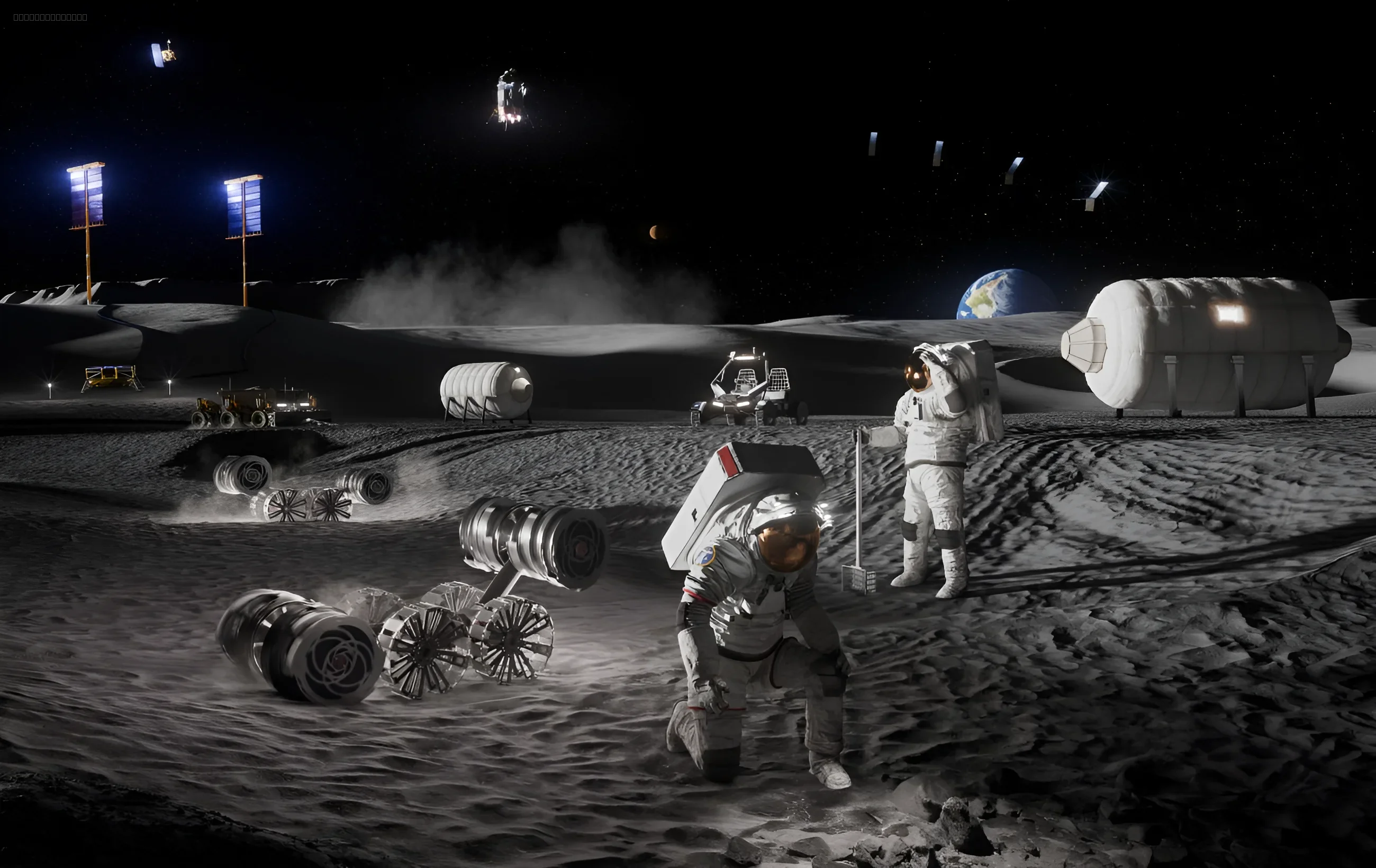
The era of lunar expeditions is ceasing to be the realm of science fiction and is moving into the stage of active construction. NASA has officially launched the process of building the first permanent base on the Moon's South Pole. This is not just another landing, but the beginning of creating a full-fledged infrastructure where technology and human labor will combine in the harsh conditions of space.
The agency is no longer waiting, but acting: contracts worth hundreds of millions of dollars have been signed, and four leading American companies have begun developing equipment capable of surviving in an extreme environment. There is no place for random players in this project — every element, from the landing module to the drone, must work flawlessly.
Technological Alliance: Bezos, Musk, and New Players
At the heart of the future base's logistics lies a powerful partnership. Jeff Bezos's Blue Origin company has taken on the critically important task of creating two landing modules. They will become the "trucks" delivering heavy equipment and rovers to the surface. The vehicles for moving across the lunar soil are being developed by specialized firms Astrolab and Lunar Outpost, creating machines capable of maneuvering where a regular car would get stuck instantly.
Special attention is paid to reconnaissance. The first to be sent to the Moon will be drones from Firefly Aerospace. This choice is not accidental: the company has already proven its reliability last year, and now its unmanned vehicles must prepare the site by conducting a preliminary analysis of the terrain.
Strategy of "Equipment Before People"
The main principle of the "Artemis" program is safety and preparation. All equipment must arrive at the destination before the astronauts. This will allow for the creation of a safe environment and ensure the crew's life support from the first minutes of landing. The first human landing is scheduled for 2028, and active preparation for the "Artemis-3" mission will begin next year.
Astronauts will practice docking the "Orion" capsule in Earth's orbit, using landing modules from Blue Origin and Elon Musk's SpaceX. This will become the general rehearsal before the real flight.
Economy and Science: Why is this important?
NASA's goals go far beyond a simple flag and footprints on the surface. The main task is to stimulate the lunar economy. The Moon is viewed as a testbed for unique scientific research and, even more importantly, as a testing ground before the leap to Mars. By refining survival and resource extraction technologies on Earth's satellite, humanity is taking the first step towards colonizing the Red Planet.
"For those who wait patiently, the grand return is already close, and we will not slow down. We are actually just getting started," NASA states, emphasizing the irreversibility of the process.
Ukraine's Role in the Lunar Race
Ukraine has real chances to become part of this historic project. NASA is showing interest in the capabilities and engines developed by the "Pivdenne" Design Bureau. The State Space Agency of Ukraine has already signed agreements on the principles of cooperation in the civilian exploration of the Moon, Mars, comets, and asteroids. Despite existing nuances and geopolitical complexity, integration into the "Artemis" program opens new horizons for the Ukrainian space industry.


