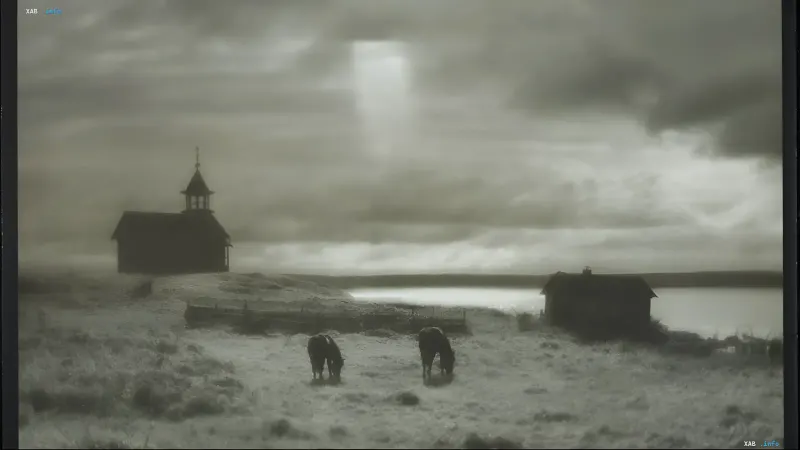
On November 3, 2026, the exhibition "The Nature of Photography," dedicated to landscape photography in Russia, opened at the Tretyakov Gallery on Krymsky Val (Krymsky Val, 10, Hall 82). The exposition includes about 130 works by more than 30 authors, with many pieces being shown to the public for the first time. The project will run until March 28, 2027. Alongside works from the gallery's own collection, visitors will see photographs by winners of the international mobile photography contest HUAWEI XMAGE, which brings together both amateurs and professionals, including in the landscape genre. The curator of the exhibition is Nikita Erofeev.
From imitating painting to an independent language
The central idea of the exposition is to trace the evolution of photographic interest in Russian nature: from early experiments oriented towards painting traditions to contemporary artistic practices. The exhibition shows how, for over a century, photography gradually developed its own artistic language and became an independent way of interpreting the landscape rather than merely an illustration of the pictorial canon.
Pictorialism and Constructivism: two poles of the landscape
The earliest works in the exposition are pieces by Evgeny Vishnyakov, Nikolai Mescherin, and Igor Grabar, reflecting the desire to solve traditional artistic tasks using the means of the new art. In the 20th century, photography increasingly became a space for experimentation. The exhibition presents two contrasting approaches: the pictorialism of Nikolai Andreev, who used soft-focus lenses and special printing techniques to move away from the precise recording of reality, and the constructivism of Alexander Rodchenko, for whom the natural motif was an occasion for experiments with composition and angles. In both cases, the landscape acted not only as an object of shooting but also as a space for artistic research and work with audience perception.
Landscape as a space for artistic research
The exposition reveals a variety of approaches to depicting nature. In the photographs of Moscow Oblast architecture by Vadim Kovrigin, nature formally remains a secondary character, yet it is not perceived as a background and often plays a key role in the frame. The works of Anatoly Erin, created during an expedition to Valaam dedicated to the plein-air geography of Ivan Shishkin, have the character of documentary research. Nikolai Kulyabykin, in turn, combined panoramic landscape views with vivid outdoor impressions, finding poetry in the contemplation of nature.
Photography as a fixation of artistic practices
A special place in the exposition is occupied by photography as a means of recording other artistic practices. The exhibition features photographs of performances by the "Collective Actions" group, experiments with artifacts by Francisco Infante, and land art works by Nikolai Polissky. Thus, the landscape photograph here acts both as a document and as an independent statement.
Conclusion: over a century of the photographic gaze
By bringing together works from different eras and artistic movements, the exhibition "The Nature of Photography" shows that throughout its history, photography developed simultaneously as a means of documenting reality and as an independent artistic statement. The project reveals the diversity of approaches to depicting nature and the possibilities of photographic art, tracing the path from the late 19th century to the present day.