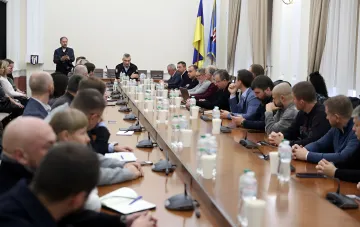
In the face of full-scale war, the ability to stop massive bleeding, apply a tourniquet, and act correctly before medical professionals arrive can be the deciding factor in saving a life. This is why basic tactical medicine skills are currently being shared not only among military personnel but also among the civilian population. The 3rd Recruitment Center of the Ukrainian Navy organized a practical training session at the Kyiv City State Administration's 'Communication Center,' featuring combat medics from the 18th Separate Anti-Tank Brigade and the 38th Marine Brigade. The instructors possess years of experience working on the front lines, including in the most intense sectors.
Who conducted the training and why it matters for civilians
A key idea of the event, emphasized by the instructors, is that specialized medical education is not required to provide first aid. 'Civilians do not necessarily need specialized medical education to help a casualty. But basic knowledge is essential. In our reality, a person must understand how to stop massive bleeding, assess the wounded person's condition, and act correctly until specialists arrive,' explained combat medic Yaroslav. The goal of the training, as noted by the 3rd Navy Recruitment Center, is not to turn civilians into professional medics, but to provide them with the minimum necessary set of knowledge and skills for critical situations where those decisive minutes before help arrives can be the difference between life and death.
What's inside a soldier's individual first aid kit
One of the practical topics of the session was a detailed breakdown of an individual first aid kit. Among the essential items, instructors listed a tourniquet, hemostatic and standard bandages, a trauma bandage, trauma shears for cutting clothing, disposable gloves, and occlusive seals used for penetrating chest wounds. Combat medic Vitaliy emphasized that first aid equipment can save lives, and it is important not only to have a kit at home, in a car, or carry a small set, but also to know the purpose of each item and be able to use it in practice.
The MARCH algorithm: A sequence that saves lives
A significant part of the theoretical block was dedicated to the MARCH algorithm used in NATO tactical medicine. It assumes a clear sequence of actions based on the principle of prioritizing threats to life. The first step is to stop massive bleeding, as with certain wounds, a person can lose a critical amount of blood in minutes. Next, airway patency is checked, breathing and circulation are assessed, head injuries are identified, and hypothermia is prevented. The latter point — hypothermia — is relevant even in warm weather, as significant blood loss itself creates a risk of the body becoming dangerously cold.
The PAWS block and moving to practice
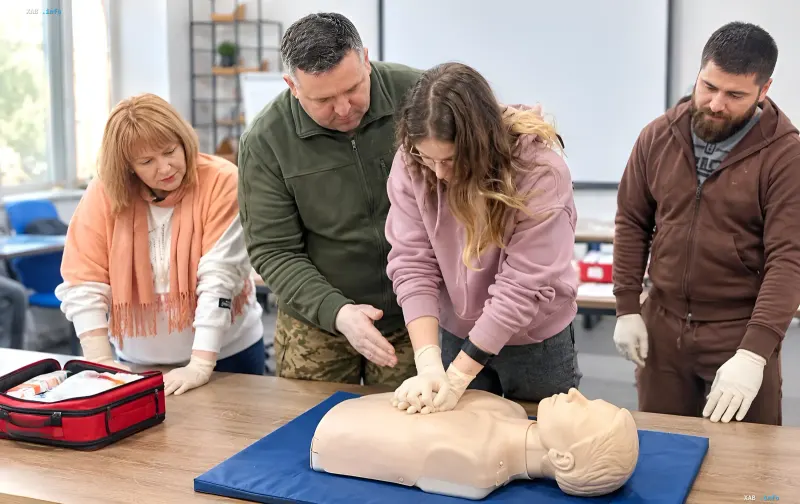
Following the main stages of MARCH, the instructors proceeded to the additional PAWS block, which covers pain management, infection prevention, assistance with other types of wounds, and splinting injured limbs. The theoretical part gave way to practical application: under the guidance of combat medics, civilian participants practiced applying tourniquets, packing wounds, applying bandages, and performing other medical assistance actions. Photos from the event show participants in disposable gloves practicing techniques on a mannequin while instructors correct their execution.
Participant experience: From theory to action
Engineer Oleksiy, one of the civilian participants, shared his impressions: 'I had some theoretical knowledge about medical assistance and was interested in the topic on my own. But reading about these things is one thing, and seeing them in practice, hearing explanations from specialists, and trying to apply the knowledge myself is completely different.' His words reflect the organizers' general approach: practical training, not just reading instructions, builds the skill that works automatically in a stressful situation. The 3rd Navy Recruitment Center emphasizes that in wartime, the ability to stop bleeding in time, use a tourniquet correctly, and stay calm until medics arrive can prove decisive for the victim's life.