
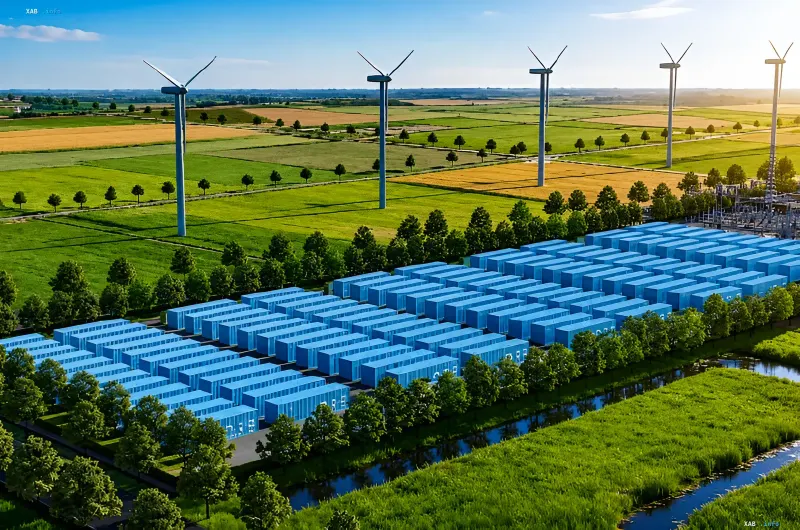
The Netherlands has launched a project that could revolutionize how Europe stores energy over the coming decades. In partnership with a leading national energy conglomerate, developers have begun construction of a massive energy storage facility with a capacity of 1 gigawatt-hour. This is Europe's largest Long-Duration Energy Storage (LDES) project based on "iron-air" technology.
The complex is designed to solve one of the main problems of modern energy: the instability of renewable sources. Wind turbines in the North Sea do not always operate at the required intensity, and the sun does not shine 24 hours a day. This new system is being created precisely to level out these daily and seasonal fluctuations.
How the "rusty" battery works
The new installation is based on the principle of reversible iron oxidation. Instead of the expensive and scarce components used in familiar lithium-ion batteries, this system uses accessible chemical elements. The system's operation is divided into two cycles:
- Generation mode (discharge): When energy is needed, the system draws oxygen from the air. This triggers controlled oxidation of the metallic iron inside the cells, causing electrons to flow into the grid.
- Accumulation mode (charging): Excess energy from wind turbines and solar plants is fed to the electrodes. Iron oxide (essentially rust) is restored to pure metal, and oxygen is returned to the atmosphere.
The main technological advantage of this scheme is time. While standard industrial lithium systems can deliver energy for 2–4 hours, the iron-air installation is designed for continuous operation from 100 to 150 hours. This allows the system to cover energy needs even for a whole week.
Economics and safety
The economic feasibility of the project is obvious. According to analysts, the capital costs to create 1 kWh of capacity in such systems could be 10 times lower than lithium counterparts. The secret lies in the materials: replacing cobalt, nickel, and lithium with commercial iron and aqueous electrolyte significantly reduces the cost of the structure.
Furthermore, iron-air cells lack the main drawback of lithium batteries—the risk of thermal runaway. This eliminates the possibility of large-scale fires and allows storage facilities to be located in close proximity to major industrial zones and consumption nodes without compromising safety.
Role in Europe's energy balance
The deployment of buffer capacity in the Netherlands is dictated by the need to solve the problem of wind power volatility. Without such accumulators, the market faces two extremes: negative electricity prices during strong winds and a power shortage during prolonged calm (the Dunkelflaute phenomenon).
In the context of the European Green Deal, scaling such LDES systems is seen as a critical step. The goal is to reduce the EU countries' dependence on reserve gas turbine power plants by 2030, which are traditionally used to smooth consumption peaks, and make the transition to "green" energy truly stable.


