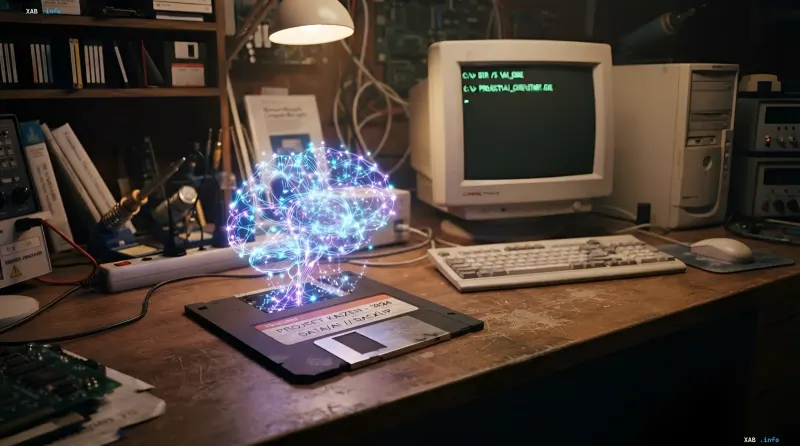
In a world where large language models demand server farms of thousands of graphic accelerators and terabytes of memory, a developer known as WollyMonjac has proven that artificial intelligence can fit onto a storage medium that still remembers the scent of magnetic tape. His project, Tiny 2.1, is a compact neural network designed to run in a DOS environment on computers equipped with Intel 486DX and Pentium processors. The entire software package, along with the model weights, fits onto a standard 1.44 MB 3.5-inch floppy disk, and requires approximately 540 KB of free RAM to run. For context, a typical early 1990s Pentium computer was equipped with 8–32 MB of RAM, making Tiny 2.1 fully compatible with the hardware of that era.
A 367,000-Parameter Transformer in Turbo C 2.0
It is important to point out immediately: Tiny 2.1 is not a large language model in the conventional sense. It is a small transformer designed for question-answering, written in Turbo C 2.0—a compiler that was the industry standard in the DOS era. The model's architecture includes four layers, and all weights are stored in an 8-bit format, allowing them to fit into approximately 380 KB. The total number of parameters is about 367,000—orders of magnitude fewer than modern LLMs, but sufficient for specialized conversational interaction within a given knowledge base.
Trained on 3,500 Facts with a 1994-Era Interface
The model has been trained on approximately 3,500 facts, with each fact included in the training set in multiple phrasing variations to improve question recognition robustness. The user interface completely replicates the aesthetics of old DOS applications: the screen displays a window for entering questions, dialogue history, and a neural network status monitoring panel. A unique highlight of the project is the ability to output answers via a synthesized robotic voice through the computer's built-in speaker—for an era when speech "from the speaker" felt like science fiction, this feature gives Tiny 2.1 the character of a true retro demo.
Hallucinations, Fine-Tuning, and the MIT License
The developer honestly warns: beyond the knowledge embedded in the model, Tiny 2.1 is capable of confidently inventing answers, thus demonstrating the classic behavior of generative models encountering an unfamiliar query. However, the project includes a folder for additional training, allowing users to independently expand the fact base and adapt the neural network to specific topics. The program is distributed under the MIT license, which permits free use, modification, and distribution of the code, including commercial applications. This makes Tiny 2.1 not just a novelty, but a potential foundation for educational projects, retro computer clubs, and experiments with "lightweight" AI on constrained resources.
Why This Matters in 2026
At a time when the AI industry is moving towards increasingly heavy and energy-intensive architectures, projects like Tiny 2.1 remind us of a fundamental principle: intelligence does not have to be infinitely large to be useful. For retro computing enthusiasts, students studying the basics of neural network architectures, and simply curious users who have a Pentium computer with a floppy drive sitting on a shelf, Tiny 2.1 provides a rare and accessible way to experience transformer models "in the flesh"—without cloud services, GPUs, or subscriptions. A floppy disk, 540 KB of memory, and a robotic voice from the speaker, and the neural network answers your questions.