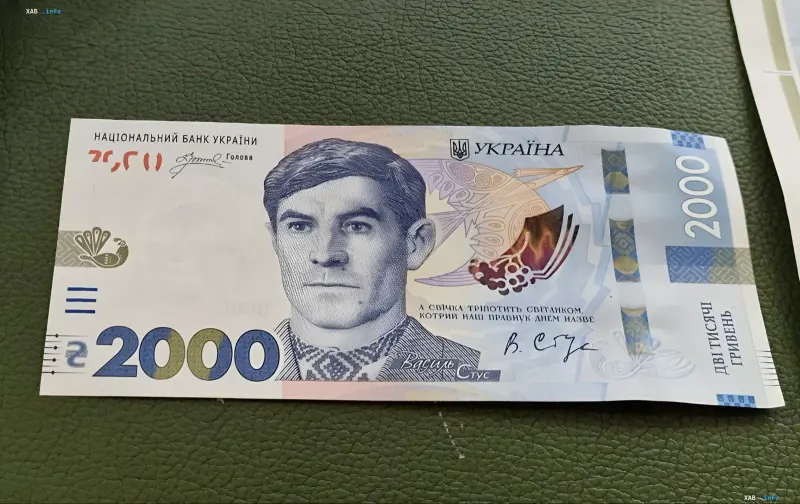
A significant event is preparing to launch in the Ukrainian monetary system. The National Bank of Ukraine has announced the introduction of a new banknote with the highest denomination — 2000 hryvnias. The face of the new banknote will be the legendary poet of the Sixtiers, dissident, and human rights defender Vasyl Stus. The official launch is scheduled for September 4, 2026 — a date chosen not by chance, but as a symbol of memory for the poet.
Visually, the banknote represents a synthesis of portrait engraving and modern graphic elements. The banknote features a portrait of Vasyl Stus, as well as a quote from his poem: «А свічка тріпотить світанком, котрий наш правнук днем назве» (And the candle flickers with the dawn, which our great-grandson will call day). The Head of the National Bank, Andriy Pyshnyy, emphasized that the new banknote will be equipped with more than 20 advanced security features, confirming the status of the hryvnia as one of the most secure currencies in the world.
Legal Aspect: Whose Face Is It?
In addition to artistic and technical characteristics, the appearance of Stus's portrait on money has raised a number of interesting legal questions. After all, the poet passed away in 1985, and the use of his image is regulated by civil legislation norms and the Law "On Copyright and Related Rights".
Anna Zhakot, Head of the Intellectual Property Practice at Nota Group, explains that in this case, two parallel permission mechanisms are in effect. First, the right to use the image of a deceased person belongs to their heirs of the first order: children, spouse, or parents. Consequently, from a legal point of view, it is Vasyl Stus's family that possesses the right to grant or deny permission for the placement of his portrait on the banknote.
Is there a possibility to avoid this consent? Anna Zhakot notes that Part 3 of Article 308 of the Civil Code of Ukraine exempts the need to obtain consent if the image is used to protect the interests of other persons. However, according to the expert, the publication of the portrait on a banknote does not fall under this category, as it does not serve the purpose of protecting the interests of third parties.
Copyright and Public Domain
The second important aspect concerns the copyright on the photograph itself. It belongs to the photographer or their heirs. The term of protection is the life of the author plus 70 years. If this term has expired, the work enters the public domain.
The expert draws a parallel with existing banknotes featuring Bohdan Khmelnytsky and other historical figures. In their case, the copyright protection terms have long expired, and the images are in the public domain. The situation with Vasyl Stus, whose life and work belong to the 20th century, is legally more complex, and there could have been a need to obtain a license to use the photograph or create an image based on it.
The Question of Royalties
A natural question arising in connection with the use of the image: will the poet's family receive financial remuneration? Anna Zhakot gives a clear answer: yes, theoretically this is possible, but not mandatory. By law, providing consent for the use of an image does not provide for automatic payment. A fee may be paid, but this depends on agreements, not on strict legislative norms.
RBC-Ukraine attempted to get a comment from Vasyl Stus's son, however, he has so far refused to comment on this issue officially. Nevertheless, the appearance of the poet's portrait on the highest denomination banknote will become an important step in immortalizing the memory of Ukrainian culture and the history of resistance.


