

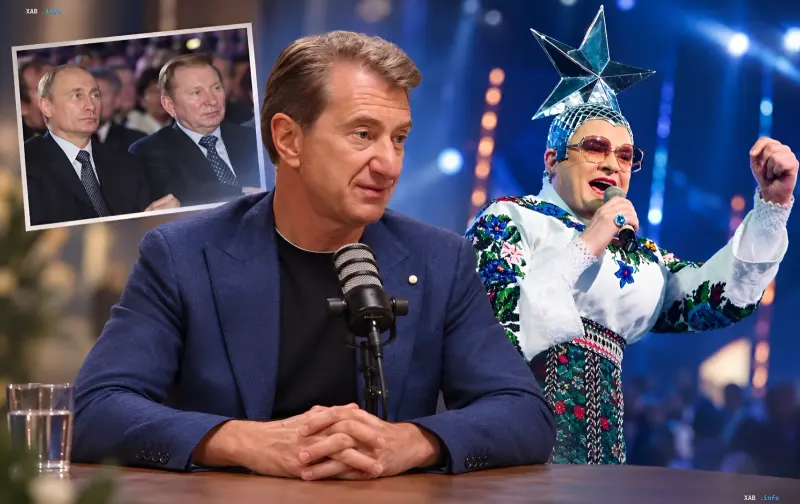
Yuriy Nikitin, the producer who managed the career of Verka Serduchka (Andriy Danylko) for many years, shared little-known episodes from the Ukrainian star's life prior to her 2007 Eurovision triumph in an interview with blogger Vasyl Tymoshenko published by Styler. His recollections include performing before two presidents, negotiations with Radio Russia, and relocating a concert from the State Kremlin Palace to Luzhniki.
The concert attended by Putin and Kuchma
Nikitin called the corporate event featuring both Vladimir Putin and Leonid Kuchma the "most interesting" of his career. According to him, it was a concert organized specifically for the two presidents, and they were likely the only attendees in the venue. At the same time, the producer honestly admitted he could not remember the exact location, year, or title of the performance. He also mentioned how Verka Serduchka first met Putin: according to his version, Danylko initially invited someone from the entourage, after which Putin himself summoned the artist. "Serduchka talked about this many times, and Danylko did too. That's how they met. But what year it was, I honestly don't know anymore," Nikitin added.
Pugacheva-level popularity: negotiations with Radio Russia
Nikitin illustrated the scale of Serduchka's Russian success prior to Eurovision through an episode involving the general director of Radio Russia. He was offered to have Verka Serduchka co-host the Golden Gramophone awards alongside Alla Pugacheva in exchange for broadcasting her songs on the radio. The producer recalled that the artist's album released a year earlier had already legally sold one million copies, even though it had not yet received radio airplay. "Considering that piracy levels back then were at 95%, imagine how many disks people bought with their own money. And this without a single song on Radio Russia. So we weren't going to work for free," Nikitin stated. In the end, the parties agreed on a fee and established cooperation.
Cancellation at the Kremlin Palace and 40,000 tickets at Luzhniki
Nikitin described the situation regarding the concert at the State Kremlin Palace as one of the most dramatic episodes. Three weeks prior to the show, the team was informed without explanation that the concert would not take place. "We were simply in shock," the producer recalled. Instead of canceling, the team moved the event to Moscow's Luzhniki sports complex and sold 40,000 tickets within two to three weeks—which, according to Nikitin, was equivalent to two sports arenas. "Back then, no artist drew crowds like that. The level of popularity was unimaginable and indescribable. And all this happened even before Eurovision," he concluded.
Context: from Russian-language album to the Eurovision stage
Verka Serduchka became one of the most recognizable figures of the Ukrainian pop scene in the early 2000s. In 2003, the artist released her first Russian-language album, which sales archives show sold over a million copies in Ukraine and Russia. In 2004, the record won a Muz-TV award for Album of the Year. Serduchka cemented her international presence in 2007 when she represented Ukraine at Eurovision in Gelsenkirchen with the song "Dancing Lasha Tumbai", finishing in second place. Her performance in the persona of a train attendant wearing a distinctive star headpiece remains one of the most quoted acts in the contest's history.
Nikitin's recollections, published in October 2026, provide a rare insider perspective into the public space: how the Ukrainian star's relations with the Russian market were built, how management decisions were made amidst cancellations and negotiations, and how the massive scale later validated on the Gelsenkirchen stage was formed.


