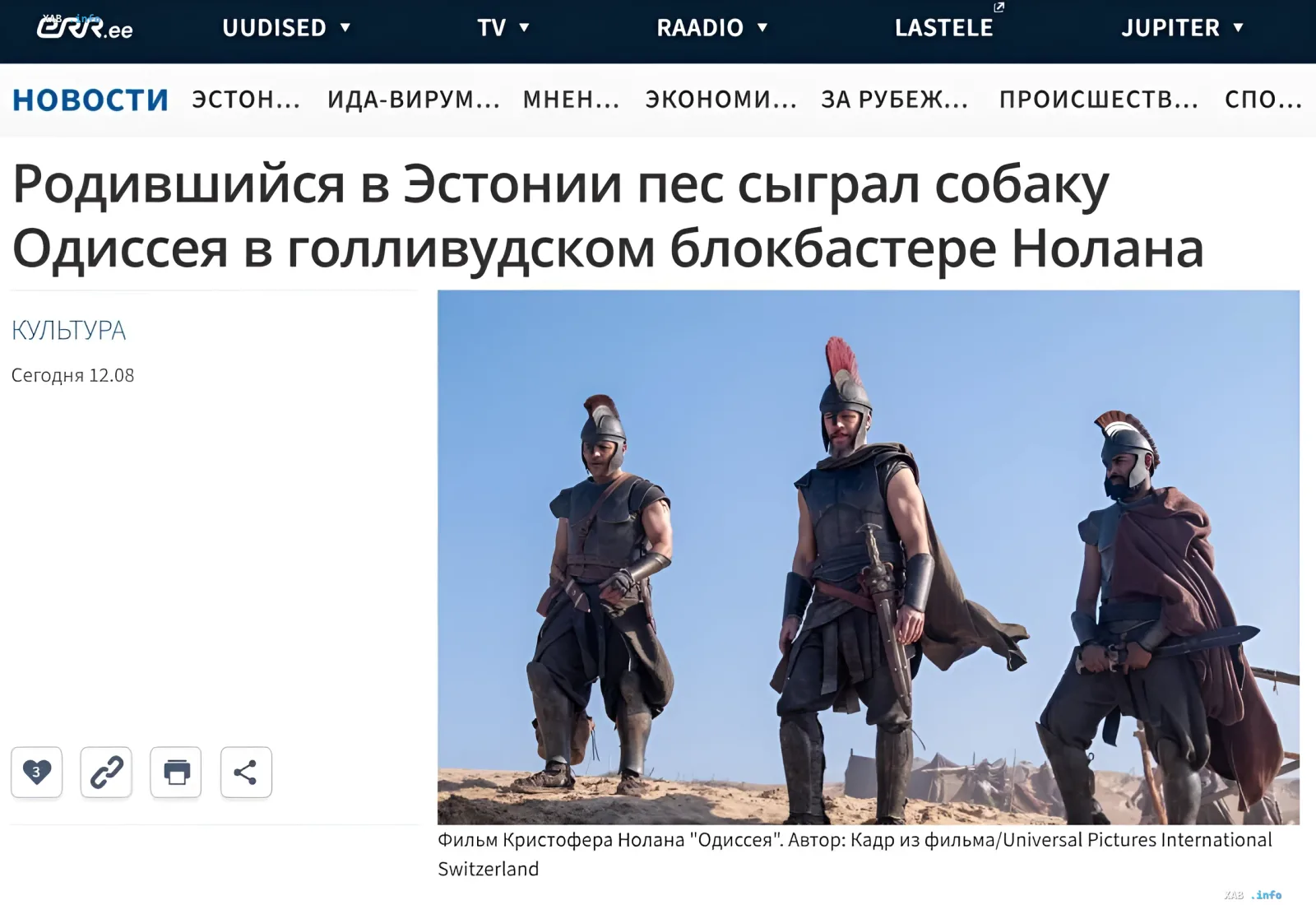
A viral story has been sweeping social networks this week: it is claimed that Christopher Nolan personally reached out to Estonian authorities and kennels with a 'custom order' to breed a puppy for his new blockbuster 'Odyssey.' Headlines buzzed, reposts flew, and commenters were already dissecting what genetic project Tallinn had launched. In reality, the story is far more prosaic — and at the same time more interesting. Behind the loud clickbait lies a real, yet perfectly ordinary tale of exporting a puppy of a rare breed, which ultimately led the four-legged actor straight onto the set of one of the most anticipated films of the year.
Three dogs, one role: how Nolan filmed Argos without CGI
In the released large-scale blockbuster 'Odyssey,' the loyal dog of Odysseus, Argos, was played at different ages by three real dogs of a rare hunting breed — the Portuguese Podengo. The director categorically refused computer graphics: according to the plot of Homer's poem, the dog appears on screen at various ages, and Nolan insisted on live filming. The production team needed three similar dogs at once to show Argos growing up without digital manipulation. It was precisely this staging nuance — and not some 'secret Hollywood project' — that became the catalyst for the viral headlines.
A corsair from Estonia: how a puppy ended up in California
One of the four-legged actors — a four-year-old male dog named Corsair — was indeed born in Estonia. His breeder, Iren Naarits, proudly told the story in the morning broadcast of the Terevisioon show on the national broadcaster ERR. There was no state breeding 'to order for a director': Corsair was sold as a puppy to American owners. Already in California, the dog was noticed by professional animal trainers who were preparing doubles for the filming of 'Odyssey.' On set, the trainers compared Corsair's trainability to Belgian Malinois shepherd dogs — the dog only needed a command shown once, which earned him screen time in the key scenes of Odysseus's return to Ithaca.
Why the Portuguese Podengo: an ancient phenotype without anachronism
The Portuguese Podengo is one of the oldest Mediterranean hunting sighthound breeds, whose phenotype has remained virtually unchanged over the past couple of thousand years. Breeding of this breed outside of Portugal is carried out by a handful of kennels in the world. For Nolan, who builds every frame of 'Odyssey' like an archaeological reconstruction, this was critically important: most modern European breeds would have looked like a crude anachronism on screen. The Podengo, on the other hand, fit organically into the ancient setting, without pulling the viewer out of the era.
Contradictory data
Here it is worth honestly addressing the discrepancy between versions. Viral headlines on social networks and in some media presented the story as 'Nolan ordered a dog in Estonia' or 'Estonia bred a puppy for Hollywood on a special order from the director.' Estonian breeder Iren Naarits and the Terevisioon material paint a completely different picture: this is a standard sale of a puppy of a rare breed to American owners, after which the dog was discovered by Hollywood trainers already on US soil. There were no personal appeals from Nolan to Estonian kennels, no state breeding programs. The difference between 'export of a rare-breed puppy who happened to be needed on set' and 'the director ordered a dog' is fundamental, and it was precisely this that was lost in the chain of reposts.
What this means for cinema and for Estonia
The story of Corsair is not a sensation, but a pleasant side effect: a rare breed, bred by only a handful of people in the world, gained global visibility thanks to a single frame in a single film. For Estonia, this is also a soft cultural export: the national TV channel proudly broadcasts that a four-legged Hollywood actor was born right here. And for Nolan — yet another confirmation of his reputation as a director who is ready to give up an entire CGI budget for one live look from a dog on screen and film three real Podengos at different ages.